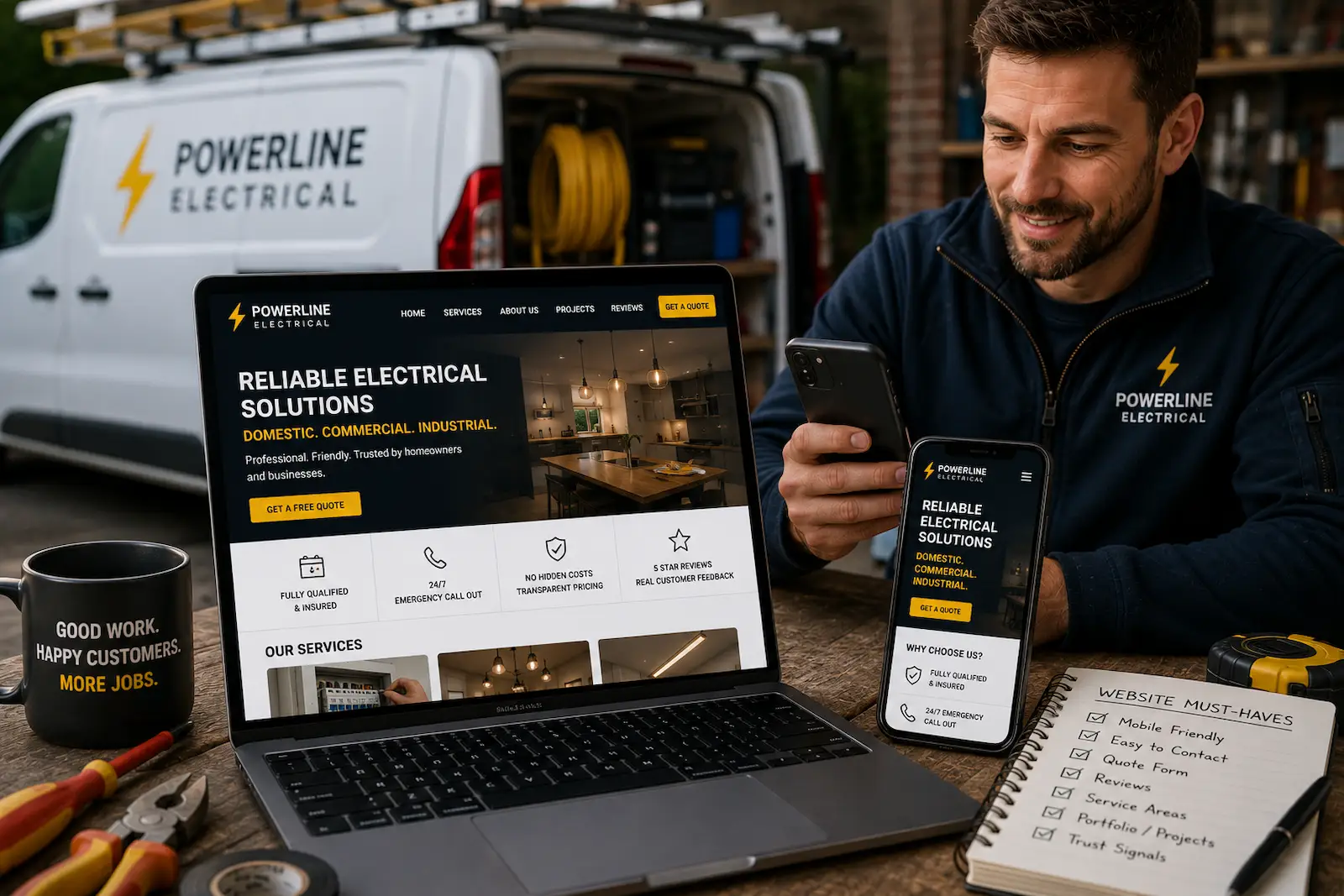
Some people believe their website just needs to look nice and the calls will come flooding in, like a burst pipe clearly needing to be fixed.
Whether you're a plumber, electrician, roofer, carpenter, landscaper, builder, painter, or another skilled tradesperson, your website should make it easy for customers to understand what you do, trust your business, and get in touch.
Unfortunately, many trade websites still suffer from the same problems. They're slow, difficult to navigate, and missing the information customers are actually looking for.
Many also look like they were built around the same time as dial-up internet.
The good news is that you don't need an expensive or complicated website.
You simply need the right features.
In this guide, we'll explore the most important website features every trades business should include.
A Clear Homepage
This is the only guaranteed part of your website which will be seen. Within a few seconds of arriving on your website, visitors should know:
- What you do
- Where you work
- Who you help
- How to contact you
A good homepage immediately answers these questions.
For example:
Professional Plumbing Services Across Location
is much more useful than:
Building Excellence Since 2005
The second sounds impressive but doesn't actually tell the visitor very much.
Clarity almost always beats clever wording. Many users won't stick around to scroll down your website and discover this information, so it needs to be clear and obvious as soon as they land on your website.
A clear homepage is only one part of an effective trade website. Learn more in What Makes a Good Trade Website?.
Individual Service Pages
Giving every major service its own page comes with multiple benefits.
For example, a website with pages focused on:
- Boiler Repairs
- Roof Repairs
- Kitchen Fitting
- Garden Landscaping
- House Rewiring
- Driveway Installation
These separate service pages help customers find exactly what they're looking for.
They also give search engines a better understanding of your business, and a potential client immediately knows that your business can complete the service they require.
Focusing these pages on your most profitable services can also help ensure your business gets enquiries based on the type of jobs you want to complete.
Clear Service Area Information
Customers need to know whether you work in their area.
Include:
- Towns
- Counties
- Regions
- Coverage maps (if appropriate)
If you work across several locations, consider creating dedicated location pages with useful local information.
This supports both user experience and local SEO. Customers dealing with an emergency usually want someone nearby, so clearly showing that you cover their area can significantly increase the chances of winning the job.
Location pages can dramatically improve your visibility in nearby searches. Read Why Local SEO Matters for Tradespeople.
A Simple Contact Form
Some people prefer to call.
Others would rather send a message.
Give customers both options.
A contact form should only ask for information that's genuinely needed.
For example:
- Name
- Phone number
- Location
- Type of work
- Brief description
If the form feels like applying for a mortgage, some visitors simply won't bother.
Ensuring the form is secure, simple to use, and complies with local regulations (for example GDPR in the EU) is extremely important. Customer data should be collected securely and handled in accordance with relevant privacy regulations.
Click-to-Call Phone Numbers
Many visitors arrive on your website using their phone.
Make your phone number clickable.
This allows customers to contact you immediately without copying and pasting numbers.
It's a small feature that can make a surprisingly big difference.
Offering click-to-call buttons or WhatsApp contact options can increase conversions by making it as easy as possible for potential customers to get in touch.
Genuine Customer Reviews
Reviews help remove uncertainty.
Potential customers want reassurance before inviting someone into their home or business.
Display reviews throughout your website, particularly:
- On service pages
- Near quote forms
- Beside calls to action
- Within project galleries
The most convincing reviews describe real experiences rather than simply saying "Great job!"
Make asking for reviews part of your normal workflow so your review profile continues to grow over time.
Reviews are one of the strongest trust signals your business can have and can improve both credibility and local search visibility.
A Project Gallery
People like seeing proof.
A gallery allows customers to view the quality of your work before making contact.
Include photographs of:
- Completed projects
- Before-and-after transformations
- Close-up workmanship
- Larger installations
- Finished details
Always use genuine images whenever possible.
Real projects build far more trust than generic stock photos.
A brief description of the project, when it took place, and other details (with the customer's permission, of course!) will help potential clients see it as a genuine and reliable project.
Before-and-After Images
Transformation sells.
Whether you're replacing a roof, renovating a bathroom, building fitted furniture, or laying a new patio, before-and-after images clearly demonstrate the value of your work.
Customers can immediately see the difference you've made.
And everyone enjoys a satisfying transformation—it's much cheaper than watching home renovation programmes all weekend.
Strong Calls to Action
Every important page should clearly tell visitors what to do next.
Examples include:
- Request a Free Quote
- Call Today
- Book an Inspection
- Contact Our Team
- Get a Fast Estimate
Don't make visitors guess how to become a customer.
Guide them towards the next step.
A Mobile-Friendly Design
Most trade websites now receive a large percentage of visitors from mobile devices.
Your website should:
- Load quickly
- Display correctly on smaller screens
- Use readable text
- Have easy navigation
- Include large buttons
- Keep contact information visible
If customers have to zoom in every few seconds, they'll probably zoom straight over to a competitor instead.
Older websites often struggle because they weren't designed with modern mobile devices in mind. Technology continues to evolve, so keeping your website up to date is important for attracting new customers.
Mobile-friendly websites also support SEO and improve the overall customer experience. Learn more in Why Mobile-Friendly Websites Matter for Tradespeople.
Fast Loading Speeds
Website speed matters.
Slow websites frustrate visitors and can reduce enquiries.
Improve speed by:
- Compressing images
- Using modern image formats
- Removing unnecessary scripts
- Choosing reliable hosting
- Keeping the design clean
Customers usually notice slow websites long before they notice clever animations.
A loading animation was fine in the 2000s, but not anymore. People are impatient and want speed and clarity, so a high-performing website will often outperform one that's simply "luxury designed."
Trust Signals
Visitors need confidence that your business is genuine.
Useful trust signals include:
- Years of experience
- Public liability insurance
- Trade qualifications
- Manufacturer certifications
- Guarantees
- Industry memberships
- Verified customer reviews
Only display credentials your business genuinely holds.
Authenticity always beats exaggeration.
An About Page
Customers often want to know who they're hiring.
Your About page should explain:
- Your experience
- Your values
- Your team
- Your approach
- Areas you cover
Adding photographs of yourself, your team, or your vans helps make the business feel more personal.
People prefer hiring people rather than anonymous companies.
Giving a backstory to your business, your mission, or your overall aim can also add a human element to your website. After all, people are looking to hire a person to complete the work, not just admire attractive photos or glowing reviews.