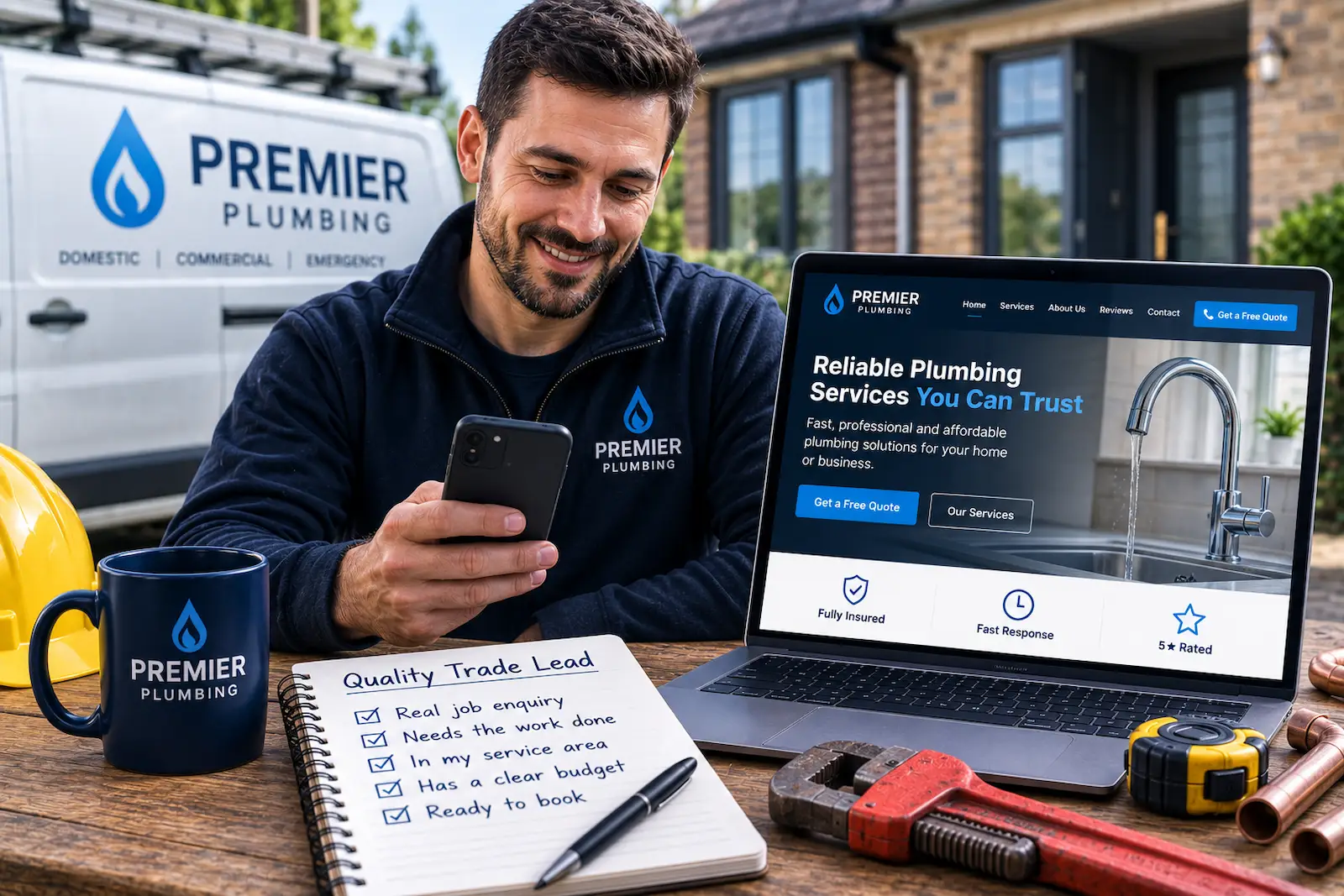
It's very common for tradespeople to say they want more leads.
A better question would be:
Do you actually want more leads… or better quality ones?
There is a major difference between receiving lots of enquiries and receiving the right enquiries.
Twenty enquiries from people who are "just seeing what it might cost" are rarely as valuable as five enquiries from customers who are genuinely ready to hire someone.
The most successful trades businesses don't simply chase the highest number of enquiries. Instead they focus on attracting the right enquiries.
In this article, we'll explore what makes a high-quality trade lead, why lead quality matters more than lead quantity, and how you can generate more of the customers you actually want to work with.
Not Every Lead Has the Same Value
A lead is simply someone who has shown an interest in your services. It could be from a phone call, an email, or even a chance conversation on the street.
That doesn't automatically make them a good prospect, as one enquiry might be:
- A homeowner ready to replace an entire roof this month.
While another might be:
- Someone asking for five different quotes before deciding whether they'll even start the project next year.
Both are technically considered leads, but in terms of business, only one is likely to become profitable work in the near future.
A Good Lead Has a Genuine Need
The strongest enquiries usually come from customers who actually need the work completed.
Examples include:
- A leaking roof after a storm
- A broken boiler
- A consumer unit that keeps tripping
- A customer planning a kitchen renovation
- A business requiring electrical work before opening
These customers are looking for solutions rather than simply browsing.
That often leads to higher conversion rates.
They Are Looking for Your Services
A quality lead should match the work you actually want to do.
For example:
A carpenter specialising in bespoke fitted furniture may receive an enquiry about repairing a garden gate.
It is still a lead.
It just may not be the right lead.
The more closely your marketing reflects your preferred services, the more relevant your enquiries become.
They Are in Your Service Area
Location matters. Getting a fantastic enquiry from three hours away may not always be practical.
Good marketing helps attract customers within the areas you actually serve.
This is one reason why local SEO and location pages are so valuable.
They help connect your business with nearby customers who are more likely to become paying clients.
Focusing on nearby customers can help improve your reputation in the local area while also reducing your costs for the work.
Learn more about improving your local visibility in Why Local SEO Matters for Tradespeople.
They Have a Realistic Budget
Not every customer knows exactly what a project will cost.
That is perfectly normal.
Actually, it can be an advantage for the tradesperson. There is a difference between someone who wants guidance and someone expecting a complete extension for the price of a takeaway pizza.
Setting realistic expectations on your website can help attract customers whose budgets better match the work involved.
Charging appropriately for your work is important, but customers also need to feel they are receiving good value. Fair pricing combined with quality workmanship is far more likely to lead to positive reviews and repeat business.
They Are Ready to Make a Decision
Timing plays a major role.
Some enquiries are:
- Ready to book this week.
- Planning work within the next month.
- Gathering information for a future project.
All of these enquiries have levels of value.
However, customers who are actively planning to hire someone usually represent the highest-quality opportunities.
Customers who are ready to move forward and have realistic expectations are often the highest-quality leads.
They Trust Your Business
A customer who already trusts your business is much more likely to become a paying customer.
Trust is built through:
- Google reviews
- Project galleries
- Professional websites
- Clear communication
- Helpful content
- Recommendations
These features mean that by the time some customers contact you, they've already decided you're one of the businesses they'd be happy to hire.
That's a much better starting point than trying to convince a complete stranger and hoping they take you on your word.
Building trust before someone contacts you is one of the biggest advantages of a strong online presence. Learn more in How Tradespeople Can Get More Customers.
They Contact You Directly
One of the strongest signals of a high-quality lead is when a customer contacts your business directly.
This often happens through:
- Your website
- Google Business Profile
- Phone calls
- Contact forms
- Referrals
These enquiries are often more valuable than leads shared with multiple contractors.
The customer chose to contact you, rather than responding to a general marketplace listing.
Tracking the route a client discovered your business is also important for your future marketing focus.
Direct enquiries through your own website and Google Business Profile are often far more valuable than shared leads. Read Should Tradespeople Buy Leads? to understand the difference.
They Match Your Ideal Customer
Every trades business has projects they enjoy more than others.
Perhaps you're a roofer who prefers full roof replacements.
Or an electrician focusing on commercial work.
Or a landscaper specialising in complete garden transformations.
Your marketing should attract the type of customer that fits your business goals.
More enquiries are not always better if they're for work you no longer want to take on.
Focus on the jobs which benefit you, and your business, the most.
Lead Quality Is Better Than Lead Quantity
Imagine two businesses.
Business A
- 100 enquiries
- 10 jobs won
- Average job value: €250
Business B
- 20 enquiries
- 4 jobs won
- Average job value: €2,000
Which business would you rather own?
The answer is obvious.
The goal is not to fill your inbox.
It's to fill your diary with profitable work.
Some jobs are more profitable than others, so finding the right balance for your business will help push its trajectory towards future success.
Good Marketing Improves Lead Quality
One of the biggest misconceptions about marketing is that it only increases the number of enquiries.
In reality, good marketing also improves who contacts you.
For example:
- Clear service pages attract customers looking for those services.
- Local SEO attracts nearby customers.
- Project galleries attract customers who value quality.
- Helpful content educates potential clients before they contact you.
- Customer reviews build confidence.
The result is often fewer time-wasting enquiries and more genuine opportunities. No system is perfect, but making it easier for the right customers to contact your business is better than attracting all potential customers.
Good marketing isn't just about generating more enquiries—it also helps attract better ones. Learn more in Why Tradespeople Should Treat Marketing as an Investment.
Why Cheap Leads Can Be Expensive
Buying low-cost leads might seem attractive.
A constant supply of leads for a fixed price—what could go wrong?
Cheap leads come with hidden costs.
You may spend time:
- Returning calls
- Visiting properties
- Preparing quotations
- Following up
- Competing against several other businesses
If very few become paying customers, the true cost of each successful job becomes much higher.
Sometimes the cheapest lead is the most expensive one you'll ever chase. Often they are sold to multiple businesses, meaning you're paying to compete rather than paying for an exclusive opportunity.
The saying "you can't win if you're not in" certainly applies, but it's still important to weigh the value of those leads against other long-term marketing investments.
Many successful trades businesses gradually reduce their reliance on bought leads by investing in long-term marketing assets. Learn how in How Tradespeople Can Generate Leads Without Paid Ads.
Ask Better Questions
You can improve lead quality by asking a few simple questions when customers get in touch.
For example:
- What type of work do you need?
- Where is the property?
- When would you like the work completed?
- Do you have photos?
- Have you set a budget?
These questions help determine whether the enquiry is a good fit before investing too much time.
Always ask politely and in a friendly, conversational manner:
"Where did you get my number?"
Tracking where your customers come from means you can focus on the right channels to generate fewer enquiries but far more completed jobs.
That's valuable information when deciding where to invest your marketing budget.
Focus on Long-Term Relationships
A high-quality lead doesn't always stop after one project.
Many customers return for future work or recommend your business to others.
One satisfied customer could lead to:
- Repeat projects
- Family referrals
- Neighbour recommendations
- Commercial opportunities
That long-term value is worth far more than a single transaction. The workmanship is only one part of the job. Ensuring the customer is happy with the work is just as important.
Common Mistakes When Judging Leads
Many trades businesses:
- Judge success by the number of enquiries alone.
- Ignore conversion rates.
- Accept every type of project.
- Never track where leads come from.
- Focus on cheap leads instead of profitable ones.
A smaller number of excellent enquiries is often a better outcome than a large number of poor-quality ones.
Final Thoughts
The best trade leads are not simply the first people to contact you.
They are the customers who genuinely need your services, are located within your service area, trust your business, and are ready to move forward.
Good marketing isn't just about generating more enquiries.
It is about attracting the right enquiries.
By investing in:
- A professional website
- Local SEO
- Google Business Profile
- Customer reviews
- Clear service pages
- Helpful content
you make it easier for the right customers to find your business and get in touch.
At the end of the day, one excellent lead is often worth more than twenty that were never likely to become customers. If you're looking to attract more of the right enquiries, read How Tradespeople Can Get More Customers.