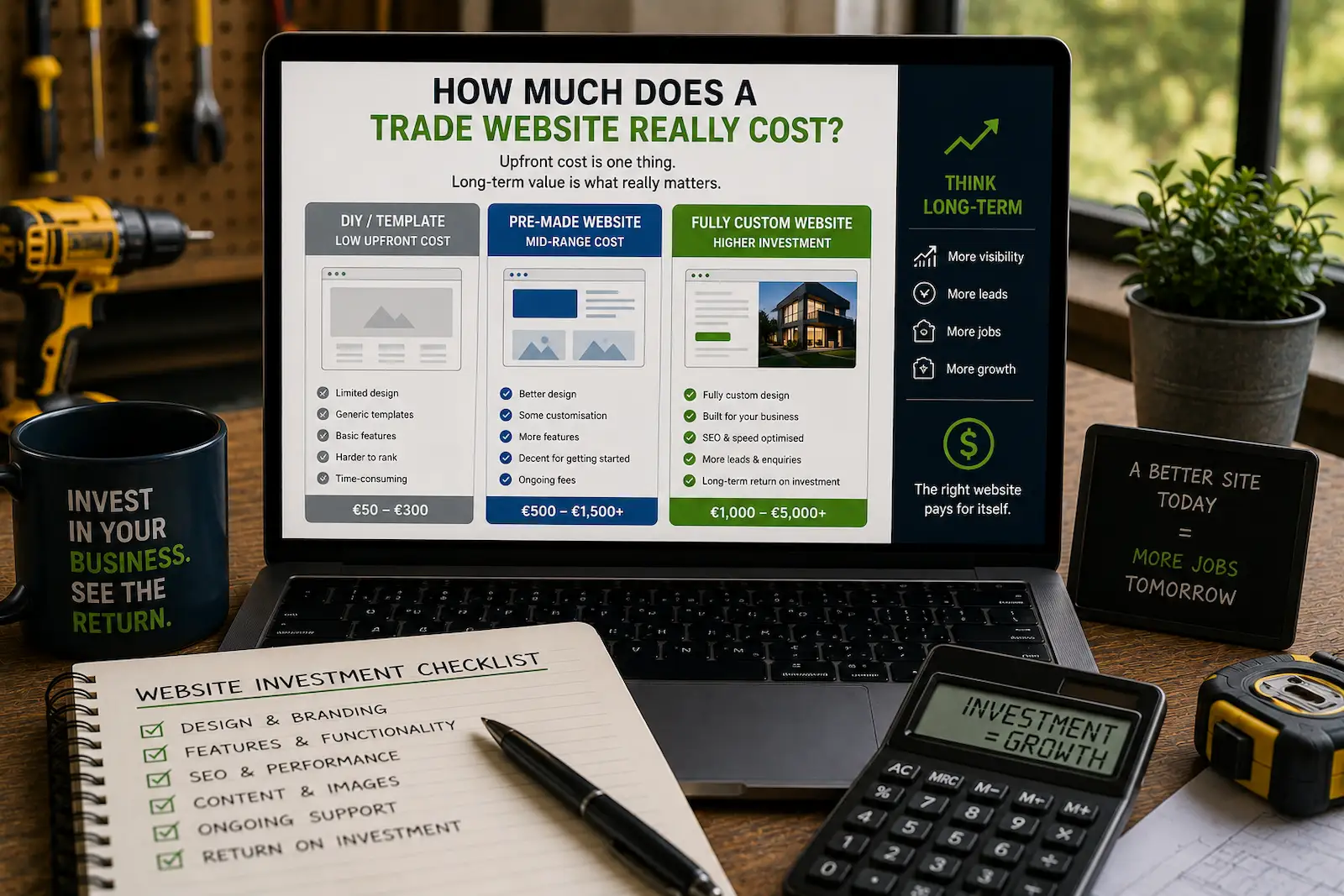
One of the first questions many tradespeople ask when looking for a new website is:
"How much is this going to cost me?"
It's a fair question, but the answer isn't always straightforward.
You can find websites advertised for a few hundred euros, while others cost several thousand.
At first glance, that price difference can seem confusing.
It's easy to assume the cheaper option offers the best value—but that's not always true.
Not all websites are built with the same goal in mind.
Some are little more than online brochures.
Others are designed to generate enquiries, improve Google rankings, and help grow a business for years to come.
In this article, we'll break down what influences the cost of a trade website and explain what you're actually paying for.
The Cheapest Website Isn't Always the Cheapest Option
Many tradespeople naturally focus on the upfront cost.
But a website should be viewed as an investment rather than an expense.
Ask yourself:
- Would you rather have a €500 website that generates no enquiries?
- Or a €2,000 website that wins multiple new customers every year?
The value of a website isn't measured by what it costs.
It's measured by what it helps your business earn.
What Affects the Cost of a Trade Website?
Several factors influence the final price.
These include:
- Number of pages
- Custom design
- SEO optimisation
- Copywriting
- Project galleries
- Contact forms
- Mobile optimisation
- Speed and performance
- Ongoing support
The more planning, design, development, and optimisation involved, the higher the investment. It's no different to hiring a plumber or electrician—the more complex the job, the more time and expertise it requires.
Basic Template Websites
Template websites are usually the most affordable option.
They often include:
- Home page
- About page
- Services page
- Contact page
They're suitable for businesses that simply want an online presence.
However, they may offer fewer opportunities for customisation and lead generation.
For many tradespeople, a template website is a sensible starting point.
It provides an affordable way to establish an online presence.
As the business grows, the website can always be upgraded to something more customised if required.
If you're comparing different types of websites, read Template Websites vs Fully Custom Websites to understand the advantages and disadvantages of each approach.
Professionally Built Websites
Professional websites are designed around the needs of your business.
Rather than simply looking attractive, they're built to:
- Generate enquiries
- Improve SEO
- Build trust
- Showcase your work
- Convert visitors into customers
Creating this type of website usually involves more planning, design, and development than simply customising an existing template.
A professional website should be designed to generate enquiries rather than simply look attractive. Learn more in What Makes a Good Trade Website?.
Custom Websites
Fully custom websites provide the greatest flexibility.
They often include:
- Bespoke layouts
- Advanced SEO
- Custom functionality
- Project galleries
- Service area pages
- Lead generation tools
Custom websites generally require a larger investment but are often built with long-term growth in mind.
Another advantage of a custom website is its flexibility. As your business grows, it's much easier to add new features, pages, and functionality without being limited by the constraints of a template.
Don't Forget Ongoing Costs
Building the website is only part of the investment.
Most businesses will also need to budget for ongoing costs.
These may include:
- Website hosting
- Domain name
- Maintenance
- Security updates
- Content updates
- SEO
- Support
- New pages or layouts
Keeping your website updated helps maintain security, performance, and compatibility over time. A neglected website can gradually become slower, less secure, and less effective at generating enquiries.
Why SEO Can Increase Website Costs
Some websites are built with very little attention given to SEO.
Others are designed from the beginning to help rank on Google.
SEO work may include:
- Keyword research
- Page optimisation
- Technical SEO
- Internal linking
- Service area pages
- Blog content
While this increases the initial investment, it can significantly improve long-term results.
Building SEO into a website from the beginning gives it a much stronger foundation than trying to add it later. It's one of the most important questions to ask when choosing a web designer or deciding to build a website yourself.
Building SEO into your website from the beginning can produce significant long-term returns. Read How SEO Can Pay for Itself for Trades Businesses to learn more.
Cheap Websites Can Become Expensive
A very low-priced website can seem like a bargain.
You're online quickly, you've spent very little, and everything appears to be working.
The problem is that many businesses later discover hidden weaknesses that require expensive fixes, such as:
- Slow loading speeds
- Poor SEO
- Weak design
- Mobile problems
- Limited functionality
- Rebuilding the website
Building the right website from the start can often save money in the long run.
Many of these hidden costs are explained in more detail in Why Cheap Websites Can Cost Tradespeople More Money.
How Much Is One New Customer Worth?
Instead of focusing only on website cost, think about customer value.
Imagine your average project is worth:
- €2,000
- €5,000
- €10,000
If your website generates just a handful of additional customers each year, it may easily pay for itself.
For many tradespeople, the return on investment is far more important than the upfront price, especially if the website continues generating enquiries year after year.
What Should Tradespeople Look For?
When comparing website providers, don't just compare prices.
Ask questions such as:
- Is the website mobile friendly?
- Is SEO included?
- Will it load quickly?
- Can I update the content?
- Does it include project galleries?
- Is ongoing support available?
A lower quote doesn't always mean better value.
Should You Choose the Cheapest Quote?
Not necessarily.
When comparing quotes, consider:
- Experience
- Portfolio
- SEO knowledge
- Website speed
- Lead generation strategy
- Support after launch
The cheapest option isn't always the one that delivers the best results.
Think About Long-Term Value
A website isn't something most businesses replace every year.
It's a long-term marketing asset.
Over time, you can continue adding:
- Reviews
- Blog articles
- New services
- Project galleries
- Location pages
This helps your website become more valuable as your business grows.
Before investing, it's worth considering the long-term plan for your website. Will you manage it yourself, or work with someone who can continue improving it as your business grows?
Common Website Buying Mistakes
Many tradespeople:
- Choose purely on price
- Ignore SEO
- Forget about ongoing maintenance
- Don't consider future growth
- Underestimate the importance of speed
Avoiding these mistakes can help you make a better long-term investment.
Final Thoughts
There isn't a single fixed price for a trade website.
The right investment depends on your business goals, the features you need, and how important your website is to winning new work.
A basic website may be enough if you simply want an online presence.
But if you want your website to rank on Google, generate enquiries, and support long-term growth, investing in a professionally built website is often worthwhile.
The real question isn't:
"How much does a website cost?"
It's:
"How much value will it create for my business over the next five years?"
For many tradespeople, that's the question that really matters.
If you're still deciding whether a professional website is worth the investment, read Are Websites Worth the Investment for Tradespeople?.