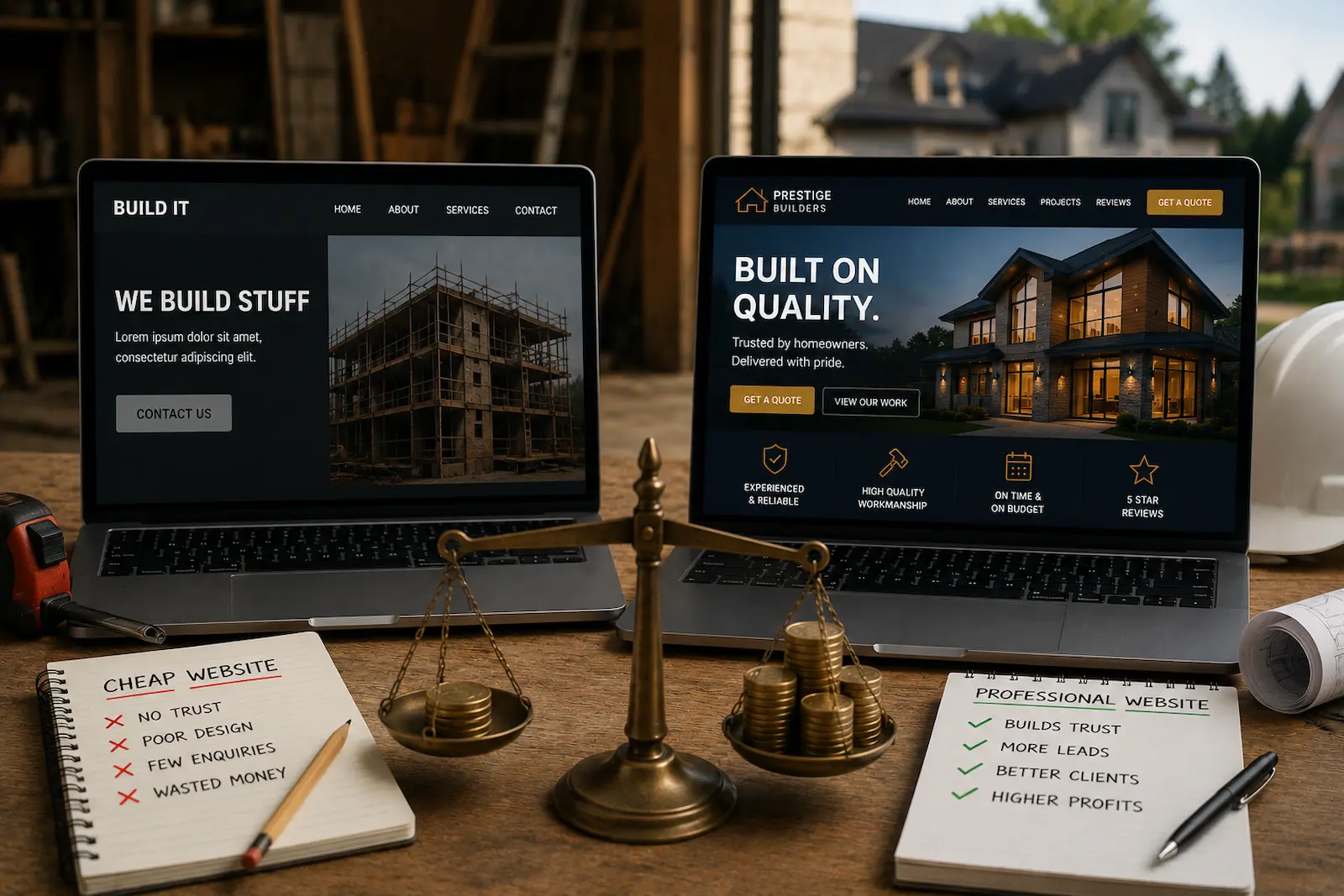
One question many tradespeople never ask when buying a website is:
"How much business will the website generate?"
Instead, when looking for a website they naturally focus on price.
After all, if one company offers a website for €300 and another quotes €2,000, it's easy to assume the cheaper option is the better deal, right?
Websites shouldn't be viewed purely as an expense. Like a homeowner hiring a plumber, quality and craftsmanship are important factors to consider.
A tradesperson should view a website the same way they view a van, a toolset, or advertising. It's an asset that should help generate revenue for the business.
The real question should never become:
"How much does the website cost?"
A cheap website that fails to generate enquiries can end up costing far more than a professionally built website that consistently brings in leads.
In this article, we'll explain why cheap websites often become expensive mistakes and how the right website can provide long-term value for trades businesses.
Cheap Doesn't Always Mean Good Value
Many tradespeople assume saving money upfront automatically means they're getting a better deal.
But value and price are not the same thing. As they know within their own trade, a business charging for quality is often worth the outlay.
Imagine buying the cheapest tools available. Or worse, imagine charging cheaper because you know the quality of your work is less than your competitors.
They may save money initially, but if the website breaks quickly or performs badly, then it often costs more in the long run. No different than fixing a leaking pipe which ends up breaking again a month or a year later.
The same principle applies to websites.
A website that fails to generate enquiries isn't a bargain.
It's a missed opportunity and can actually harm your business.
Cheap Websites Often Focus on Appearance, Not Results
Many low-cost websites look reasonable at first glance.
They may have:
- A homepage
- Some photos
- Contact information
- Basic service descriptions
On the surface, that may seem like everything a business website needs. However, looking professional and generating enquiries are two very different things.
A website should be designed to:
- Build trust
- Improve SEO
- Generate enquiries
- Convert visitors into customers
Many cheap websites overlook these goals completely and just focus on visual layouts.
Poor SEO Means Fewer Customers Find You
A major problem with cheap websites is weak SEO.
Without proper SEO, your website may struggle to appear in Google searches.
Learn more about the long-term value of search visibility in How SEO Can Pay for Itself for Trades Businesses.
It is like advertising in a local newspaper, but instead of advertising on the front page, you are lost within the middle pages which rarely get viewed.
Why This Matters
Potential customers search for terms such as:
- Plumber near me
- Electrician in Location A
- Builder in Location B
- Roofer in Location C
If your website doesn't rank, customers may never find your business. Some will, some may directly search for it after hearing off a friend or neighbour, but getting organic traffic is the real goal of a business website.
The cheapest website in the world isn't useful if nobody sees it.
Cheap Websites Are Often Slow
Website speed has a major impact on both SEO and lead generation.
Unfortunately, many low-cost websites suffer from:
- Poor hosting
- Large image files
- Bloated templates
- Poor optimisation
Why Speed Matters
Slow websites often:
- Lose visitors
- Generate fewer enquiries
- Rank lower on Google
Potential customers won't wait around while a website struggles to load. Especially in this modern age of quick searches on mobile and tablet, having an optimised modern website is a must.
Website speed directly impacts both SEO and conversions. Read Why Slow Websites Lose Trades Leads to learn more.
Mobile Performance Is Frequently Ignored
We already noted how most trade-related searches happen on mobile devices.
A website that works poorly on phones can lose a significant number of leads due to a number of problems.
Common Mobile Problems
Everything can look fine on the website, but often the cheaper websites will have:
- Small or badly designed text
- Poor layouts
- Difficult navigation or relevant sections which are impossible to find
- Broken or slow loading mobile experiences
These issues frustrate users meaning they will likely leave the website and look elsewhere. From my experience this is one of the biggest factors that reduces conversions. Views are excellent, but enquiries are what make businesses function.
Generic Templates Can Hurt Trust
Many cheap websites rely heavily on generic templates that are used across hundreds or even thousands of businesses.
This leads to businesses looking almost identical to one another.
Customers want to see a company that feels established and professional, not a mimic of the previous trade website they viewed.
A generic website can make your business appear less credible. Standing out among the crowd can be the difference between visitors staying on your site and making an enquiry, or looking elsewhere.
Cheap Websites Often Lack Local SEO
Local SEO is one of the most valuable marketing tools available to tradespeople.
Many budget websites fail to include:
- Service area pages
- Local keyword targeting
- Optimised page structures
- Internal linking
As a result, they miss opportunities to attract local customers. Being found by potential customers a hundred miles away is not as beneficial as being found in local searches.
Weak Calls to Action Reduce Enquiries
A website's main job is to encourage visitors to make contact.
Many cheap websites fail to guide users effectively. Instead they exist as a beautiful looking brochure online, but never fulfil their potential to generate customers for the business.
Examples of Weak Design
- Hidden contact details
- No quote request buttons
- Unclear calls to action
- Difficult enquiry forms
Small conversion issues can have a big impact on lead generation. Having unique features can standout for visitors and make them more inclined to follow through in contacting your business.
These are some of the same problems covered in Why Most Trade Websites Don't Get Leads.
Cheap Websites Rarely Include a Long-Term Strategy
Many low-cost websites are built as one-off projects.
Once they're launched, little thought is given to:
- SEO growth
- Content creation
- Reviews
- Performance improvements
Successful websites evolve over time. SEO should be considered a long-term strategy, not just a do-once-and-forget-about-it task. Real business assets require attention, maintenance, and in turn become stronger as they grow.
Missed Leads Have a Cost
Many tradespeople focus on what a website costs.
Fewer think about the cost of lost opportunities.
Example
Imagine a roofing company saves €1,500 on a website but misses just two roof replacement projects over the next year because the website:
- Ranks poorly
- Loads slowly
- Doesn't build trust
Those missed jobs could easily be worth far more than the initial savings.
Suddenly, the cheap website becomes the expensive option. That's without considering the compounding effect of annually getting those missed jobs.
Good Websites Can Pay for Themselves
A professionally built website doesn't need to generate hundreds of leads to justify its cost. In fact, many professionals would agree that getting high-quality leads is more valuable than a high influx of leads.
For many tradespeople, just a few additional projects can cover the investment. Even one additional project can create a strong return.
If you're weighing cost versus return, read Are Websites Worth the Investment for Tradespeople?.
Cheap Websites Can Be Expensive to Fix
Another hidden cost is rebuilding.
Many businesses eventually discover their website isn't performing.
They then need to:
- Redesign it
- Rebuild it
- Improve SEO
- Fix performance issues
This often means paying twice. Either they end up getting the website completely redesigned, or a new website build. Likely the new website will be a custom build to negate the issues encountered with the original design.
Investing properly from the start can avoid these costs. No different than getting a high-quality electrician to wire your home will save you needing to rewire again twelve months later.
What Should Tradespeople Look For Instead?
Rather than focusing purely on price, consider whether a website offers:
- Fast loading speeds
- Mobile optimisation
- Strong SEO foundations
- Local SEO targeting
- Clear calls to action
- Professional branding
- Easy contact options
These features help generate real business results. Don't be afraid to ask these questions when speaking with your website designer. Having even a basic level of knowledge can help your business avoid potential problems with your website in the future.
Many of these features are discussed in more detail in What Makes a Good Trade Website?.
The Best Website Is the One That Generates Leads
Customers don't care how much your website cost.
They care about:
- Finding your business
- Trusting your business
- Contacting your business easily
A website that generates enquiries provides value regardless of its price.
One which generates no enquiries is expensive, no matter how cheap it was.
The deciding factor should always be:
"How many calls will this website bring me over the lifetime of my business?"
Common Warning Signs of Cheap Websites
Be cautious if a website package offers:
- Extremely low pricing
- No SEO strategy
- No discussion about leads
- No mobile optimisation
- Generic templates with little customisation
- No plan for future growth
A website should be viewed as a marketing asset, not simply a digital brochure.
Final Thoughts
Cheap websites can seem attractive because of their low upfront cost.
But many tradespeople eventually discover that saving money at the beginning can cost far more later.
Poor SEO, slow loading speeds, weak lead generation, and low conversion rates can all result in missed opportunities.
A good website should help:
- Generate enquiries
- Improve visibility
- Build trust
- Grow your business
The cheapest website is not always the cheapest option. You don't need to be an expert in website design, SEO, or online marketing to make an informed decision when it comes to your business website.
For many tradespeople, investing in a website designed to generate results is ultimately the better value.