Every trades business needs leads.
Without new enquiries, even the best plumber, builder, electrician, roofer, or landscaper will eventually find the diary looking a little too empty.
The question isn't whether you need leads.
It's where those leads should come from.
Some businesses rely heavily on paid advertising or purchased leads.
Others focus on generating enquiries through their website, Google Business Profile, local SEO, referrals, and their reputation.
Both approaches can work.
But they work very differently.
In this guide, we'll compare organic and paid leads, explain the strengths and weaknesses of each, and help you decide where to invest your time and money.
What Are Organic Leads?
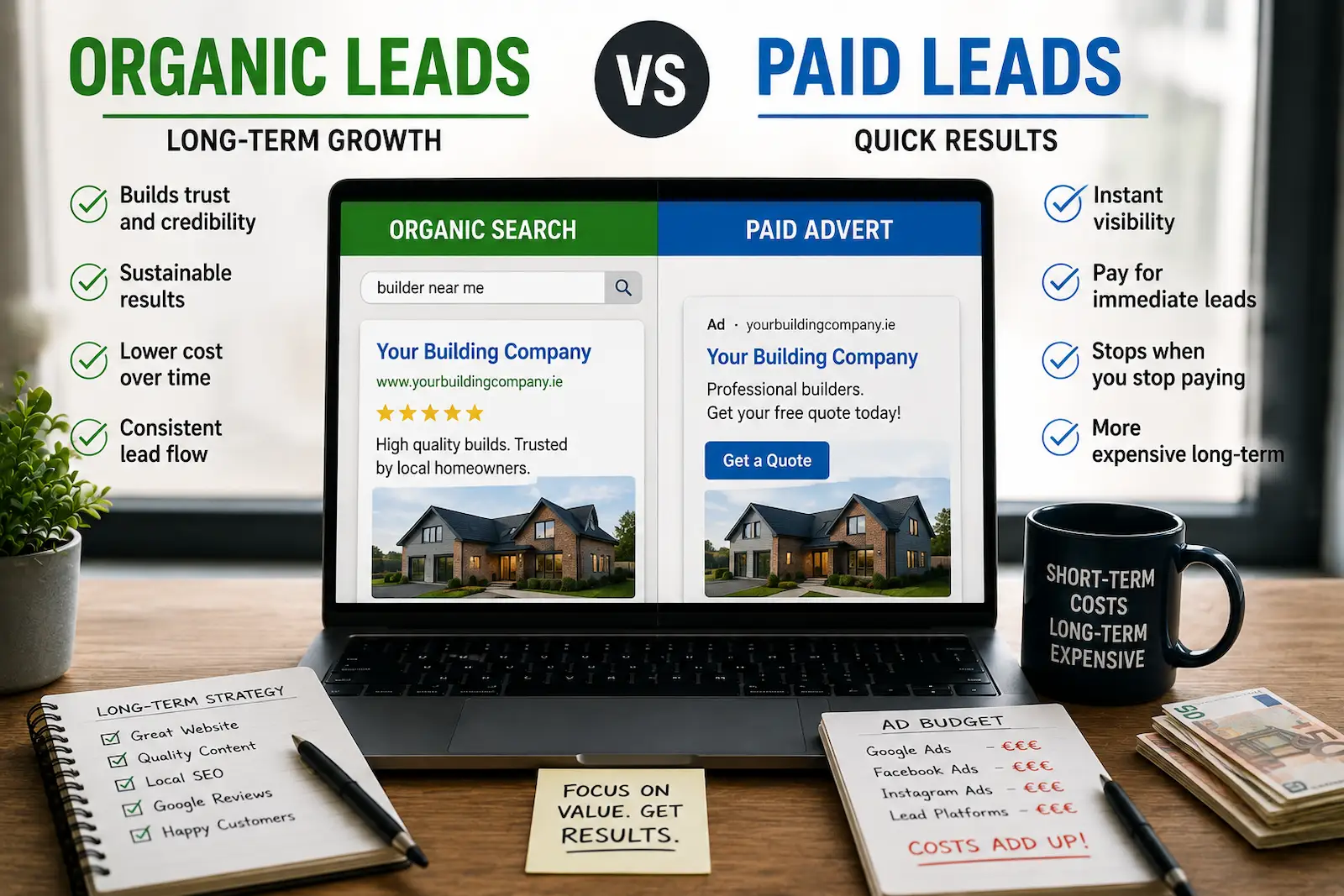
Organic leads are enquiries that come to your business naturally, without paying for each individual customer.
Common sources include:
- Google Search
- Google Business Profile
- Your website
- Local SEO
- Customer referrals
- Word of mouth
- Repeat customers
- Helpful blog content
These customers actively find your business because you've built visibility and trust over time.
Organic leads rarely appear overnight, but consistent marketing gradually builds a reliable source of enquiries.
However, it can be frustrating for some businesses to wait for this source of leads to grow and develop.
Learn why organic marketing compounds over time in Why Tradespeople Should Treat Marketing as an Investment.
What Are Paid Leads?
Paid leads come from marketing that requires ongoing spending.
Examples include:
- Google Ads
- Facebook and Instagram Ads
- Lead generation websites
- Sponsored listings
- Pay-per-click advertising
In some cases, you also pay for leads supplied by third-party marketplaces.
As long as you keep paying, enquiries usually continue.
Stop paying, and they often stop too.
Paid leads usually arrive much faster than organic leads, but the downside is the increased price per lead.
Some lead-generation services also sell the same lead to multiple contractors, meaning you're paying to compete for the same customer.
The Biggest Difference
The biggest difference comes down to ownership.
With paid leads, you're effectively renting visibility.
With organic leads, you're building an asset.
A well-ranked website, strong Google Business Profile, and excellent online reputation can continue generating enquiries long after you've finished the work that created them.
The Advantages of Organic Leads
Organic marketing offers several long-term benefits.
These include:
- Lower cost per enquiry over time
- Greater trust from customers
- Better long-term return on investment
- Consistent visibility
- Stronger local reputation
- Less dependence on advertising platforms
Organic marketing usually takes longer to build, but the results often become more sustainable.
They also compound over time, meaning each improvement increases your ability to generate future enquiries.
The Downsides of Organic Leads
Organic growth isn't instant.
It takes time to:
- Improve your website
- Build local SEO
- Collect reviews
- Publish helpful content
- Earn trust
If you're expecting page one of Google by next Tuesday, you may be disappointed.
Good marketing is a marathon, not a sprint.
It can take months before rankings improve and enquiries begin arriving consistently.
While that might be a deterrent for some, investing in your website and online marketing today can pay off in the long term.
The Advantages of Paid Leads
Paid marketing can deliver results quickly.
Benefits include:
- Immediate visibility
- Faster lead generation
- Flexible daily budgets
- Easy campaign testing
- Useful for launching new services
For businesses needing enquiries quickly, paid advertising can provide valuable momentum.
This can be especially attractive for new businesses needing to build a client base.
The Downsides of Paid Leads
Paid leads also have disadvantages.
These include:
- Ongoing costs
- Increasing competition
- Rising advertising prices
- Lower profit margins
- Dependence on advertising platforms
Some purchased leads are also shared with multiple contractors.
That means you're not only trying to win the job—you're often racing several competitors to the customer's phone.
These factors are why many tradespeople become frustrated with paid leads.
Whether they're worthwhile depends on your goals, budget, and the quality of the leads you're receiving.
Lead Quality Matters More Than Quantity
Whether a lead is organic or paid, quality matters.
A single homeowner planning a €25,000 extension is usually worth more than ten enquiries from people who were only curious about prices.
Focus on attracting customers who:
- Need your services
- Are within your service area
- Have realistic expectations
- Are ready to move forward
High-quality leads almost always outperform large volumes of poor-quality enquiries.
Generating better leads is often more valuable than generating more leads. Learn more in What Makes a High-Quality Trade Lead?.
Organic Leads Often Build More Trust
When customers discover your business through:
- Google Search
- Helpful articles
- Customer reviews
- Project galleries
- Local recommendations
they've often already built confidence in your business before contacting you.
That can make conversations easier and improve conversion rates.
A professional website helps convert that trust into enquiries and, ultimately, paying customers.
Paid Leads Can Fill Gaps
Paid marketing isn't the enemy.
In fact, it can be extremely useful when:
- Launching a new business
- Entering a new service area
- Promoting seasonal services
- Filling quieter periods
- Testing demand for new services
The mistake is relying on paid advertising forever without investing in long-term marketing.
Think of Organic Marketing as an Investment
Improving your website.
Adding project photos.
Collecting reviews.
Writing helpful articles.
Optimising your Google Business Profile.
These tasks take time.
But unlike many forms of advertising, they continue working after the initial effort.
Every improvement becomes another part of your long-term marketing foundation.
Organic marketing becomes even more effective when you understand the long-term value of SEO and your website. Read How Tradespeople Can Generate Leads Without Paid Ads.
The Best Strategy Uses Both
For many trades businesses, the strongest approach combines organic and paid marketing.
For example:
- Use Google Ads to generate enquiries while your website grows.
- Invest in local SEO to reduce advertising costs over time.
- Collect reviews from every completed project.
- Add recent work to your website regularly.
Over time, organic enquiries should make up an increasingly larger share of your leads.
Every business is different, but understanding the strengths of both approaches helps you build a more resilient marketing strategy.
Track Your Results
Don't guess which marketing is working.
Measure it.
Track:
- Number of enquiries
- Jobs won
- Average job value
- Cost per lead
- Cost per customer
- Marketing return on investment
Sometimes a channel generating fewer enquiries produces significantly more revenue.
That's where the real value lies.
One simple question—"Where did you find us?"—can become one of the most valuable pieces of marketing data your business collects.
Tracking your enquiries also helps you understand which marketing channels provide the best return on investment. Try the Marketing Budget Calculator to plan your spending more effectively.
Don't Ignore Referrals
Referrals are often overlooked during discussions about lead generation.
Yet they're one of the strongest forms of organic marketing.
Satisfied customers frequently recommend businesses to:
- Friends
- Family
- Neighbours
- Work colleagues
Excellent workmanship and customer service remain two of the most effective forms of marketing available.
People often recommend a professional service to those they know.
Avoid Becoming Too Dependent
Relying entirely on one source of enquiries creates risk.
Imagine if:
- Advertising costs doubled.
- A lead generation platform changed its pricing.
- Search rankings dropped temporarily.
A healthy business attracts customers from multiple channels.
Diversification creates stability.
A steady stream of incoming leads from different routes will help ensure you're always busy with work.
Common Mistakes Tradespeople Make
Many businesses:
- Expect instant organic results.
- Stop marketing when they're busy.
- Spend on advertising without tracking results.
- Ignore customer reviews.
- Depend on one source of enquiries.
- Focus on lead quantity instead of lead quality.
Avoiding these mistakes creates a much stronger long-term marketing strategy.
Which Is Better?
There isn't a universal winner.
If you need enquiries quickly, paid marketing can be an excellent tool.
If you're thinking about where your business will be in two, five, or even ten years, organic marketing deserves serious attention.
The strongest businesses rarely choose one or the other.
They use paid marketing strategically while continuously investing in organic growth.
Final Thoughts
Organic leads and paid leads both have an important role to play.
Paid marketing can provide speed.
Organic marketing provides stability.
By investing in:
- A professional website
- Local SEO
- Google Business Profile
- Customer reviews
- Helpful content
- Project galleries
you create marketing assets that continue generating enquiries over time.
Paid campaigns may help you win tomorrow's jobs.
Organic marketing helps build next year's business.
The smartest strategy isn't choosing sides.
It's knowing when each approach makes the most sense.
If you're deciding where to invest your marketing budget next, read Should Tradespeople Buy Leads? before making your decision.