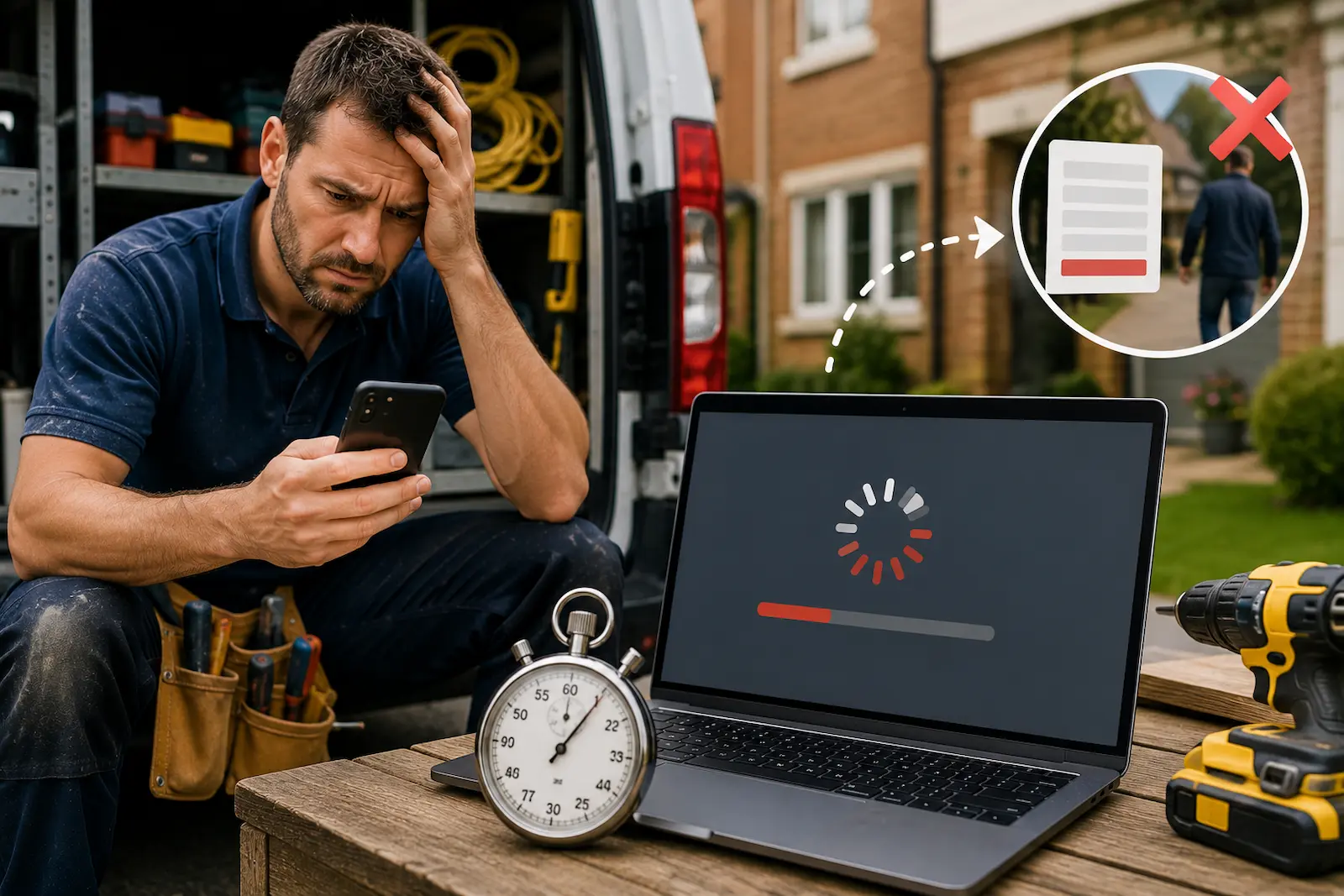
Many tradespeople struggle to get enough enquiries. They focus on how their website looks but neglect how it performs.
They invest in:
- Logos
- Colours
- Photos
- Design
But often overlook one of the most important factors:
Website speed.
A slow website can quietly cost your business enquiries every single day.
Potential customers are often searching for tradespeople because they need help quickly.
If your website takes too long to load, many visitors won't wait around.
They'll simply leave and contact a competitor instead.
In this article, we'll explain why website speed matters, how it affects SEO and lead generation, and why faster websites often outperform slower competitors.
First Impressions Happen Fast
When someone visits your website, they will create an opinion within seconds.
A slow-loading website immediately creates friction which can negatively impact the experience.
Customers may begin to wonder:
- Is this business professional?
- Is the website broken?
- Should I try another company instead?
These decisions happen quickly, and once a visitor leaves, they often don't return.
Trades Searches Often Have Urgency
Many trade-related searches involve immediate needs for emergency jobs.
Examples include:
- Emergency plumber
- Power outage electrician
- Roof leak repair
- Boiler breakdown
- Drain blockage
Customers in these situations want answers fast.
If they arrive on a website which takes several seconds to load then the likelihood is they will find another tradesperson.
The quicker your website appears, the more likely they are to stay and make contact.
Businesses that appear quickly and provide a better user experience often win more enquiries. Read What Makes a Good Trade Website?.
Slow Websites Increase Bounce Rates
A bounce occurs when someone visits your website and leaves without taking any action.
An action would include interacting with something on the webpage (such as a form input or call now button), or potentially clicking a link to another page on the site.
Slow websites often experience higher bounce rates because visitors become frustrated.
Why This Matters
Every visitor who leaves is a potential lead lost.
That means:
- Fewer phone calls
- Fewer quote requests
- Fewer enquiries
Website speed directly affects lead generation.
A potential client who cannot load your website will never contact your business. It's a lost opportunity to convert a potential customer into an enquiry.
Google Uses Website Speed as a Ranking Factor
Website speed doesn't just affect visitors.
It also affects SEO.
Google wants to provide users with a good experience.
Website speed is one of many factors Google considers when evaluating the quality and usability of a website.
Faster Websites Often Rank Better
While speed isn't the only SEO factor, it contributes to:
- Better user experience
- Longer visit durations
- Lower bounce rates
- Improved Core Web Vitals
All of these can support stronger rankings over time.
Improving rankings will lead to more people visiting your business website.
Mobile Users Are Less Patient
Most people searching for tradespeople use mobile devices.
Mobile users are generally less patient and more likely to leave a slow website in favour of a faster competitor.
Common Mobile Problems
Slow websites often suffer from:
- Large images
- Poor optimisation
- Heavy scripts
- Slow hosting
These issues become more noticeable on mobile connections.
If your website is slow on a phone, you could be losing a significant number of potential customers.
Mobile performance is more important than ever. Read Why Mobile-Friendly Websites Matter for Tradespeople.
Website Speed Impacts Conversions
Getting visitors to your website is only half the battle.
You also need those visitors to become leads.
A fast website creates a smoother experience.
This means visitors can:
- Browse services
- View project photos
- Read reviews
- Complete forms
- Call your business
without experiencing any delays.
The easier the experience is for the user, the higher the chance of conversion.
For businesses built on getting leads this is paramount to success.
More enquiries typically lead to more jobs and more opportunities for growth.
Slow Websites Make Businesses Look Less Professional
Customers often associate website quality with business quality.
A slow website can create the impression that:
- The business is outdated
- The company isn't professional
- Customer experience isn't a priority
Whether that's fair or not, perception matters.
First impressions matter, and a fast website helps create a better experience for visitors.
Why Speed Matters for Local SEO
Most tradespeople rely heavily on local customers.
Local SEO helps businesses appear for searches such as:
- Plumber in location
- Electrician near me
- Builder in location
- Roofer in location
Website speed supports local SEO efforts as it improves user experience and helps search engines crawl your site efficiently.
Website speed is just one part of a successful online presence. Read Why Most Trade Websites Don't Get Leads.
Common Causes of Slow Trade Websites
Many slow websites suffer from similar issues.
Large Image Files
Trade websites often use lots of project photos.
If these images aren't optimised properly, they can dramatically slow down loading times.
A decent website designer will understand this and have a system in place to ensure every image is optimised before being uploaded to the website.
Cheap Hosting
Low-quality hosting often results in:
- Slow page loads
- Poor reliability
- Downtime
Hosting is often overlooked, but high-quality hosting can significantly improve website performance and reliability.
Too Many Plugins
Many websites, particularly WordPress websites, become bloated with unnecessary plugins.
This can increase loading times considerably.
Every plugin should serve a purpose. Too many unnecessary plugins can slow a website and reduce overall performance.
Poor Website Builders
Some website builders create large amounts of unnecessary code behind the scenes.
This can affect performance and user experience.
While website builders can be useful, some generate unnecessary code that can negatively affect speed and performance.
Outdated Websites
Older websites often lack modern optimisation techniques and can become slower over time.
Regular updates help ensure your website continues to perform well and meet modern expectations.
Fast Websites Create Competitive Advantages
Imagine two electricians competing for the same customer.
Both offer similar services.
Both have similar prices.
But one website loads instantly while the other takes several seconds.
Which business is more likely to receive the enquiry?
In many cases, the faster website wins.
Small advantages often add up over time.
Speed Matters Even More for High-Value Leads
Some trades generate high-value projects such as:
- Extensions
- Renovations
- Rewiring
- Roof replacements
- Commercial installations
Losing even a handful of these leads each year because of a slow website can become very expensive.
Improving speed may help recover opportunities that would otherwise be lost.
Understanding the value of each enquiry can help put website performance into perspective. Read How Much Is a Lead Worth for Tradespeople?.
Fast Websites Support Every Other Marketing Channel
Website speed affects more than SEO.
It influences the effectiveness of:
- Google Ads
- Social media campaigns
- Google Business Profiles
- Referral traffic
- Email marketing
Driving visitors to a slow website reduces the effectiveness of every marketing effort.
How Tradespeople Can Improve Website Speed
There are several practical ways to improve performance:
- Optimise images
- Use better hosting
- Reduce unnecessary plugins
- Improve mobile performance
- Invest in a modern website
- Use modern image formats such as WebP
What Makes a Fast Trade Website?
Strong-performing trade websites typically have:
- Optimised images
- Mobile-friendly design
- Fast hosting
- Clean code
- Simple navigation
- Efficient page layouts
Speed should be considered a core feature, not an afterthought.
The Cost of a Slow Website
Many tradespeople never realise how many leads a slow website may be costing them.
They simply notice:
- Fewer enquiries
- Lower rankings
- Poor conversion rates
without connecting those issues to performance.
The reality is that website speed can influence every stage of the customer journey.
Many businesses focus on the cost of a website without considering the cost of missed opportunities.
A slow website may reduce enquiries, lower conversion rates, and make it harder to compete in local search results.
Presenting your business with an optimised and professional website will reflect positively on your business.
Final Thoughts
Slow websites lose leads because customers don't like waiting.
In competitive industries, people often choose the business that provides the fastest and easiest experience.
A fast website can help:
- Improve SEO
- Increase conversions
- Reduce bounce rates
- Build trust
- Generate more enquiries
For tradespeople, website speed isn't just a technical detail.
It's a lead-generation tool.
And in many cases, improving website speed can be one of the simplest ways to increase enquiries and improve marketing performance.
A fast website is one of many factors that help generate consistent enquiries. Read How SEO Can Pay for Itself for Trades Businesses.