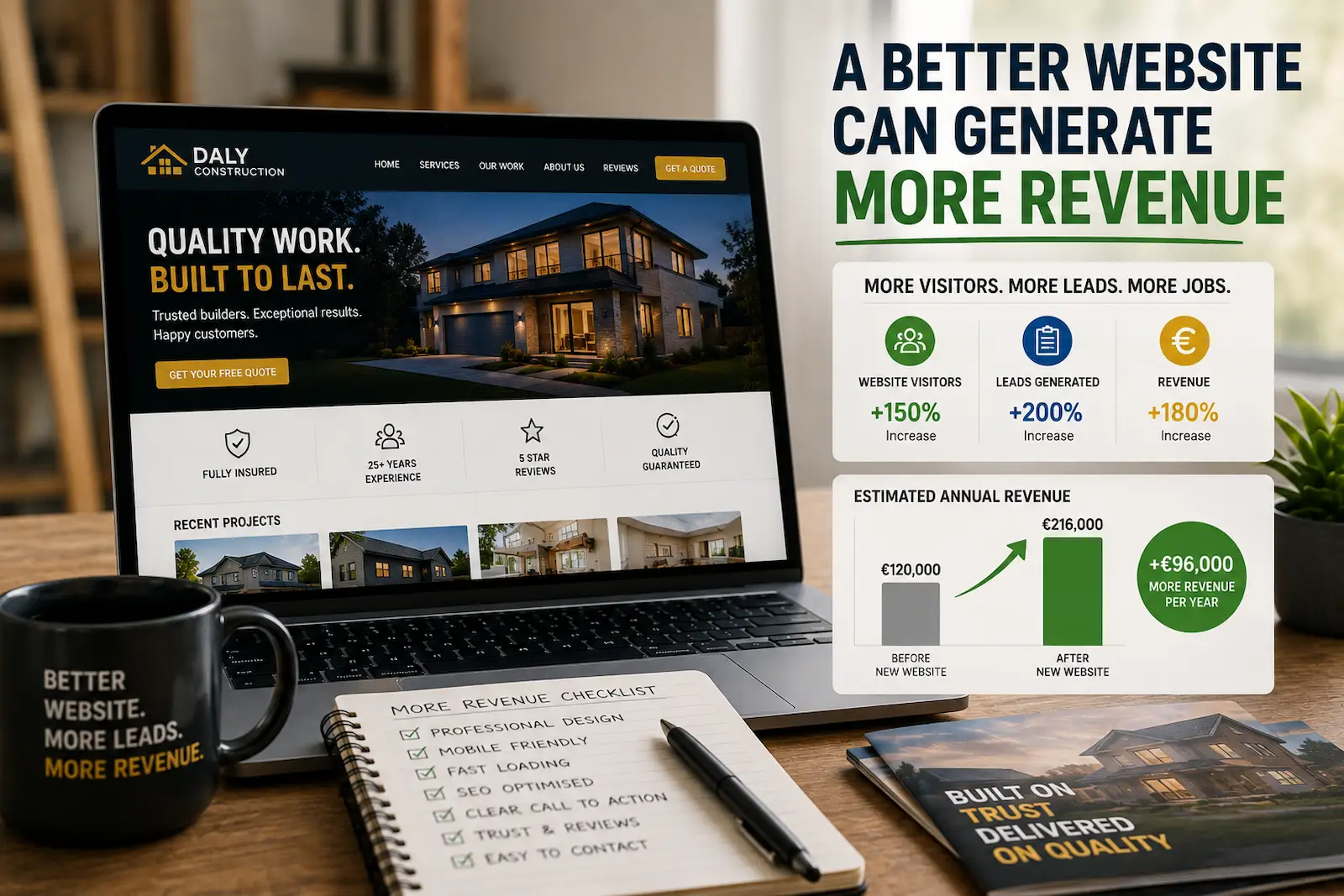
One of the most common questions tradespeople ask is:
"How much does a professional website cost?"
It's a fair question.
But there's another question that's often far more important:
"How much revenue could a better website generate?"
A website isn't just another business expense.
It's a sales tool.
If it's helping you attract more enquiries, convert more visitors into customers, and win higher-value jobs, its value can quickly exceed what you paid for it.
In this guide, we'll look at how a better website can increase revenue and why focusing only on the upfront cost often misses the bigger picture.
Your Website Works Even When You Don't
Unlike a salesperson, your website doesn't clock off at 5pm.
While you're:
- On-site
- Driving between jobs
- Preparing quotes
- Spending time with family
- Sleeping
your website can still be:
- Showing project photos
- Explaining your services
- Answering common questions
- Collecting enquiries
- Building trust
It's effectively working around the clock selling your business.
Not bad for something that never asks for tea breaks.
Learn more about what makes an effective website in Best Website Features for Tradespeople.
More Visitors Can Mean More Enquiries
A better website often attracts more visitors through:
- Local SEO
- Google Business Profile
- Helpful blog articles
- Service pages
- Location pages
The more relevant people visiting your website, the greater your opportunity to generate enquiries.
Of course, visitors alone don't pay the bills.
They need to become customers.
Want more local visitors? Read Best SEO Tips for Trades Businesses.
Better Websites Convert More Visitors
Imagine two websites.
Website A:
- Slow to load
- Outdated design
- No reviews
- Poor navigation
- Few project photos
Website B:
- Fast
- Mobile-friendly
- Genuine customer reviews
- Professional project gallery
- Clear calls to action
- Easy contact options
Which one would you trust with your home?
Most customers reach the same conclusion.
A better website usually converts a higher percentage of visitors into enquiries. When it's fast, mobile-friendly, and easy to use, visitors are far more likely to stay, explore your services, and get in touch.
Small Improvements Can Have a Big Impact
Let's imagine your website receives 500 visitors each month.
If only 2% enquire, that's:
- 10 enquiries
Now imagine you improve the website and increase the conversion rate to 4%.
You now receive:
- 20 enquiries
You haven't doubled your traffic.
You've simply doubled the number of visitors who decide to contact you.
Sometimes improving what you already have is more effective than constantly chasing more visitors.
More Enquiries Can Mean More Revenue
Suppose:
- 20 enquiries become 10 quotations
- 10 quotations become 5 completed jobs
- Each job averages €2,500
That's:
€12,500 in revenue.
If improving your website increases conversions by only a few additional jobs each month, the extra revenue can quickly exceed the cost of building the site.
Better Customers Often Find Better Websites
A professional website doesn't just attract more enquiries.
It often attracts better enquiries.
Customers who value:
- Quality workmanship
- Professional communication
- Reliability
- Experience
are more likely to appreciate a well-presented business.
That can lead to:
- Larger projects
- Higher-value work
- Better conversion rates
- Less time dealing with unrealistic enquiries
Trust Increases Revenue
People rarely spend thousands of euro with businesses they don't trust.
Trust is built through:
- Customer reviews
- Project galleries
- Before-and-after photos
- Clear service pages
- Team information
- Guarantees
- Professional design
The easier your website makes it for visitors to trust you, the easier it becomes for them to contact you.
Trust doesn't just help you win more enquiries—it often helps you win better ones.
Mobile Users Matter
Many customers search for tradespeople on their phones.
If your website:
- Loads slowly
- Has tiny buttons
- Is difficult to navigate
people often leave within seconds.
A mobile-friendly website helps capture enquiries that might otherwise disappear to a competitor.
Learn why mobile usability matters in Why Mobile-Friendly Websites Matter for Tradespeople.
A Better Website Saves Time Too
Revenue isn't the only benefit.
A better website can also reduce the amount of time you spend answering repetitive questions.
Clear service pages and FAQs help explain:
- Areas you cover
- Services offered
- How your process works
- Ways to get a quote
That means less time answering the same questions and more time focusing on your work.
Project Galleries Help Sell Your Work
Trades are visual.
Customers want proof.
A strong gallery demonstrates:
- Workmanship
- Experience
- Attention to detail
- Quality
Many visitors will spend longer looking through photographs than reading paragraphs of text.
Let your work do some of the selling.
Good SEO Keeps Bringing Visitors
A professionally built website can support:
- Local SEO
- Service pages
- Blog articles
- Location pages
Unlike paid advertising, these improvements continue working over time.
Every helpful article and every optimised page becomes another opportunity for customers to discover your business.
SEO helps your website continue generating visitors long after it's launched. Learn more in Best SEO Tips for Trades Businesses.
Think Beyond the First Job
One new customer can lead to much more than a single invoice.
That customer may also provide:
- Repeat work
- Referrals
- Google reviews
- Recommendations to neighbours
- Future projects
The lifetime value of a customer is often far higher than the value of the first job alone.
One great customer can continue generating value long after the original invoice has been paid.
Compare Cost With Potential Return
Imagine a website costs €2,000.
At first glance, that might feel expensive.
Now imagine it helps generate:
- One additional €3,500 kitchen renovation
- One €5,000 patio project
- Two extra boiler installations
- A handful of smaller repair jobs
Suddenly the conversation changes.
Instead of asking:
"How much did the website cost?"
you're asking:
"How much additional revenue did it help generate?"
Measure Your Results
Track how your website performs.
Monitor:
- Website visitors
- Enquiries
- Quotes
- Jobs won
- Average job value
- Revenue generated
Understanding these numbers helps you make better marketing decisions.
It also shows whether improvements are delivering a positive return.
Want to calculate your website's return? Try the Website ROI Calculator.
A Better Website Supports Every Other Marketing Activity
Your website strengthens almost every marketing channel.
It supports:
- Google Business Profile
- Social media
- Local SEO
- Google Ads
- Email marketing
- Referrals
When someone hears about your business, there's a good chance they'll visit your website before making contact.
Make sure it gives them confidence to take the next step.
Common Mistakes Tradespeople Make
Many businesses:
- Focus only on the cost of a website.
- Ignore conversion rates.
- Never update their content.
- Use poor-quality project photos.
- Make contacting them difficult.
- Forget about mobile users.
Improving these areas often delivers a better return than constantly increasing your advertising spend.
Final Thoughts
A better website doesn't guarantee more revenue overnight.
But it gives your business a much stronger opportunity to attract visitors, convert enquiries, and win profitable work.
Think of your website as an investment rather than an expense.
A professional website can help you:
- Generate more enquiries
- Build trust
- Win higher-value projects
- Improve conversion rates
- Support your long-term marketing
The real question isn't whether your website costs money.
The real cost isn't investing in a better website—it's losing customers because your current one isn't doing its job.
If you're still deciding whether to invest in a new website, read How Much Does a Trade Website Really Cost?.