Most people don't hire a builder on impulse.
Building work often involves significant investment, months of planning, and inviting a team of people into your home or property.
That's a big decision and is rarely done on a whim.
Before contacting you, potential customers are usually asking themselves one question:
"Can I trust this builder?"
Your website plays a huge role in answering that question.
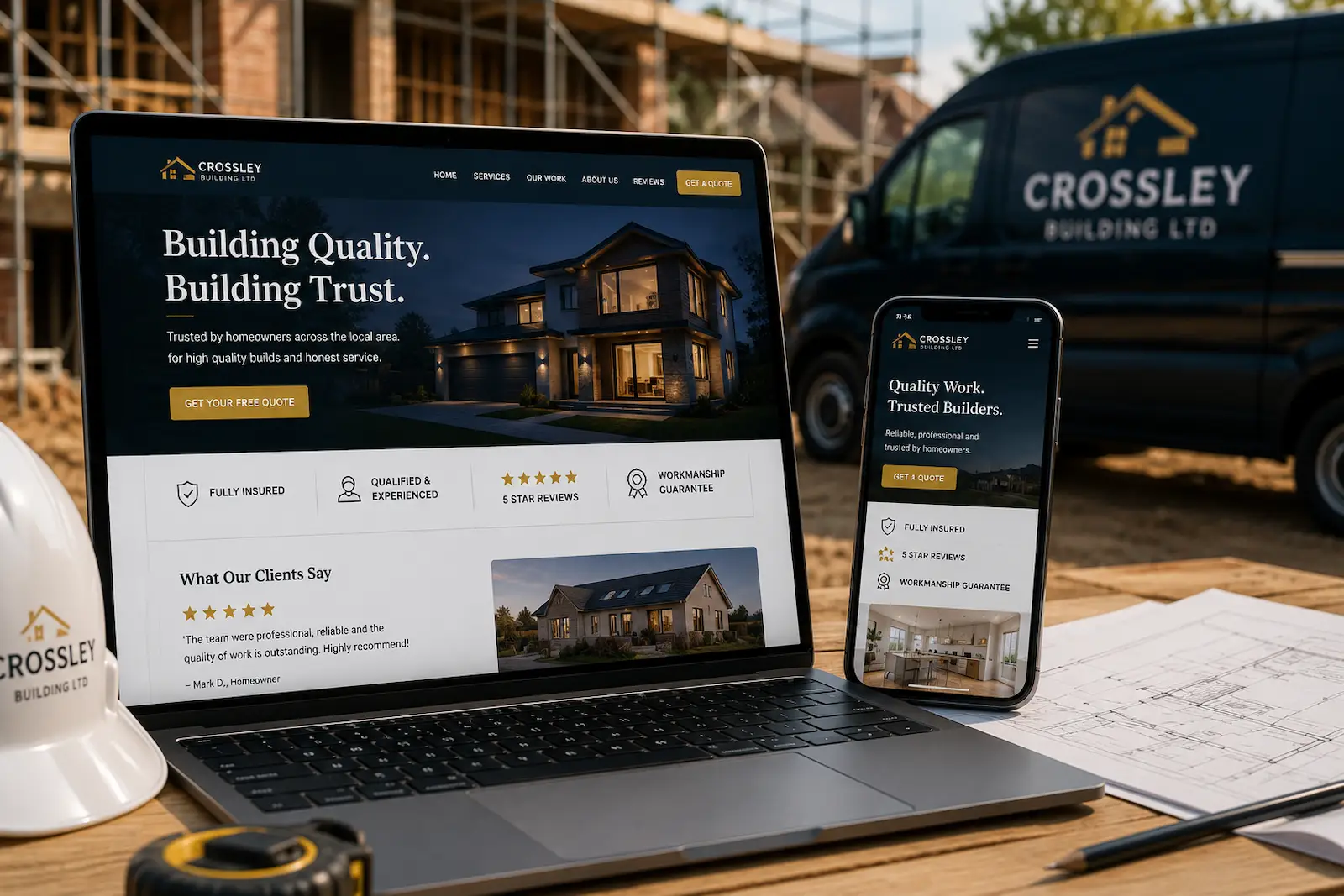
A professional builder website should do much more than list your services.
It should give visitors confidence that your business is reliable, experienced, and capable of delivering the work they're planning.
In this guide, we'll explore why trust matters so much for builder websites and how you can strengthen it.
Customers Buy Confidence Before They Buy Construction
Whether someone is planning to extend their home, a loft conversion, renovation, or a complete new build, they are making an important financial commitment.
Price certainly matters, but it's important to understand that confidence matters just as much.
Customers want to believe that:
- You'll arrive when you say you will.
- You'll communicate clearly.
- You'll complete the work professionally.
- You'll look after their property.
- You'll stand behind your workmanship.
A trustworthy website helps create that confidence before you've even spoken. When homeowners believe they'll receive reliable workmanship, clear communication, and a professional service, they're often happy to pay for quality.
First Impressions Matter
Many potential customers discover builders through:
- Google Search
- Google Maps
- Referrals
- Social media
After hearing about your business, they often visit your website.
Potential customers will form an opinion within seconds.
A clean, professional website immediately creates a stronger impression than one that's outdated, confusing, or incomplete.
Even worse, if it takes too long to load, many visitors won't stick around.
You don't get a second chance at a first impression.
Especially not when the customer has another five builders open in different browser tabs.
A professional first impression starts with the right foundations. Learn more in Best Website Features for Tradespeople.
Show Real Projects
Nothing builds confidence quite like real examples of your work.
Include photographs of completed projects such as:
- House extensions
- Renovations
- Kitchens
- Structural work
- Loft conversions
- Garden rooms
- New builds
Always use genuine photographs of your own work wherever possible.
Customers want to see what you have built, not what a stock photo website thinks a perfect extension looks like.
An imperfect photo of your own work is far more convincing than a stock image found on dozens of other websites.
Before-and-After Photos Build Confidence
Transformation photographs are particularly effective.
They allow visitors to see what the original property looked like, along with the challenges involved, before seeing the final completed result.
This helps customers appreciate both your workmanship and your ability to solve problems.
For builders, seeing the journey can often be just as persuasive as seeing the finished project.
Adding a short description of the work also helps customers understand the challenges involved and the expertise your business brought to the project.
Customer Reviews Matter
Building projects involve trust.
Reviews reduce uncertainty by showing the experiences of previous customers.
Encourage customers to leave genuine feedback after completing work.
The strongest reviews often mention:
- Communication
- Reliability
- Professionalism
- Tidiness
- Problem solving
- Quality of workmanship
Display reviews throughout your website instead of hiding them on one page.
Trust grows when visitors repeatedly see evidence that previous customers had a positive experience.
Pairing customer reviews with project photos creates even stronger social proof.
Tell People Who You Are
Many builder websites focus entirely on projects.
Don't forget the people behind the business.
Your About page should explain:
- How long you've been trading
- Your experience
- Your team
- Your values
- The areas you work in
Adding photographs of yourself, your team, or your branded vehicles helps make your business feel more approachable.
Customers hire people, not just companies.
Showing the people behind the business makes your company feel genuine and approachable.
Clearly Explain Your Services
Visitors should immediately understand what you do.
Create dedicated pages for services you provide, such as:
- House Extensions
- Renovations
- Loft Conversions
- New Builds
- Structural Alterations
- Kitchens
- Garage Conversions
Clear service pages help both customers and search engines understand your business.
If a potential client lands on a page dedicated to the exact service they need, they're far more likely to explore the rest of your website.
The more relevant information visitors find, the more likely they are to get in touch.
Clear service pages also improve your visibility in search results. Learn more in SEO for Builders Explained.
Explain Your Process
Building work can feel overwhelming for customers.
Many people have never managed a construction project before.
Explaining your process reduces uncertainty.
For example:
- Initial enquiry
- Site visit
- Quotation
- Planning and scheduling
- Construction
- Final handover
Simple explanations help customers understand what to expect.
That alone can make your business feel easier to work with.
Simple processes with clear outcomes help people feel more confident about contacting you.
Display Trust Signals
Trust signals reassure visitors that your business is genuine.
Display any trade memberships, insurance, guarantees, or recognised qualifications your business holds.
Relevant qualifications and years of experience help reassure potential customers that you're a legitimate business.
Display customer reviews and workmanship guarantees to strengthen that trust.
Only display credentials that genuinely apply to your business.
Honest trust is far stronger than exaggerated marketing claims.
Make Contact Easy
Once someone decides they trust you, don't make contacting you difficult.
Include:
- Click-to-call phone numbers
- A simple contact form
- Email address
- Service areas
- Clear calls to action
Customers should never need to search every page looking for your contact details.
Make it as easy as possible for them to get in touch.
Keep Your Website Up to Date
An outdated website can unintentionally create doubt.
Keep it current by regularly adding:
- Recent projects
- Customer reviews
- Updated service information
- Blog articles
- Team photographs
A website that continues to evolve suggests an active and well-managed business.
A neglected website quickly becomes obvious, and customers are surprisingly good at spotting one that hasn't been updated in years.
Keeping your website active also supports long-term marketing. Learn more in Why Tradespeople Should Treat Marketing as an Investment.
Publish Helpful Advice
Useful content helps establish expertise.
Potential article ideas include:
- Planning a House Extension
- How Long Does a Home Renovation Take?
- Building Regulations Explained
- Extension Costs
- Loft Conversion Ideas
Helpful content demonstrates your expertise before a customer ever contacts you.
Sharing your knowledge builds trust while improving your visibility in search results.
Professional Photography Makes a Difference
Good photography is one of the best investments for a builder's website.
Clear images help showcase:
- Workmanship
- Attention to detail
- Project quality
- Clean finishes
You don't necessarily need an expensive camera.
Modern smartphones can produce excellent results with good lighting and a tidy site.
Take plenty of photographs so you can choose the strongest ones to showcase on your website.
Keep Promises Realistic
Trust is built through honesty.
Avoid exaggerated claims such as:
- "The cheapest builder guaranteed."
- "We can build anything."
- "Every project finished in record time."
Customers appreciate realistic expectations.
It's much better to under-promise and over-deliver than the other way around.
Claims about being the "cheapest" can unintentionally make customers question the quality of your work.
Be realistic and honest—customers appreciate that far more than exaggerated marketing claims.
Mobile-Friendly Websites Build Trust Too
Most homeowners will first visit your website on their phone.
Your website should work just as well on a mobile device as it does on a desktop.
A mobile-friendly website should:
- Load quickly
- Be easy to navigate
- Display clearly
- Make contacting you simple
If visitors struggle to use your website, they may assume working with your business will be equally difficult.
A modern, mobile-friendly website reassures customers that your business is professional and up to date.
Consistency Builds Confidence
Your branding should be clear, visible, and consistent across every customer touchpoint, including:
- Website
- Vans
- Workwear
- Quotes
- Invoices
- Google Business Profile
- Social media
Consistent branding reinforces professionalism and makes your business easier to recognise and remember wherever customers encounter it.
Common Trust Mistakes Builder Websites Make
Many builder websites accidentally lose trust because they:
- Use outdated designs.
- Have very few project photos.
- Display no customer reviews.
- Hide contact details.
- Use vague service descriptions.
- Never explain who runs the business.
- Leave the website unchanged for years.
Fortunately, all of these problems can be improved.
You don't need a website that costs as much as your work van, but you do need one that builds trust and generates enquiries.
Trust Is Built Before the First Conversation
Many business owners think trust begins during the quotation.
In reality, it often begins much earlier.
By the time a customer contacts you, they may already have:
- Read your reviews.
- Viewed your projects.
- Explored your website.
- Compared you with competitors.
- Decided whether they feel confident in your business.
Your website helps shape those decisions.
Most people won't enquire with a business they don't trust.
Make sure your website gives them confidence before they ever pick up the phone.
Final Thoughts
A builder's website isn't simply a place to display completed projects.
It's one of your strongest trust-building tools.
A professional website should:
- Showcase real work.
- Display genuine customer reviews.
- Clearly explain your services.
- Introduce your business.
- Make contacting you straightforward.
- Demonstrate professionalism from the first visit.
Building trust takes time.
Fortunately, every completed project, every satisfied customer, and every useful improvement to your website adds another brick to that foundation.
Unlike some DIY projects, it's well worth getting this one right the first time.
Building trust online is one of the best ways to generate more enquiries. Read How Tradespeople Can Get More Customers for more practical marketing ideas.