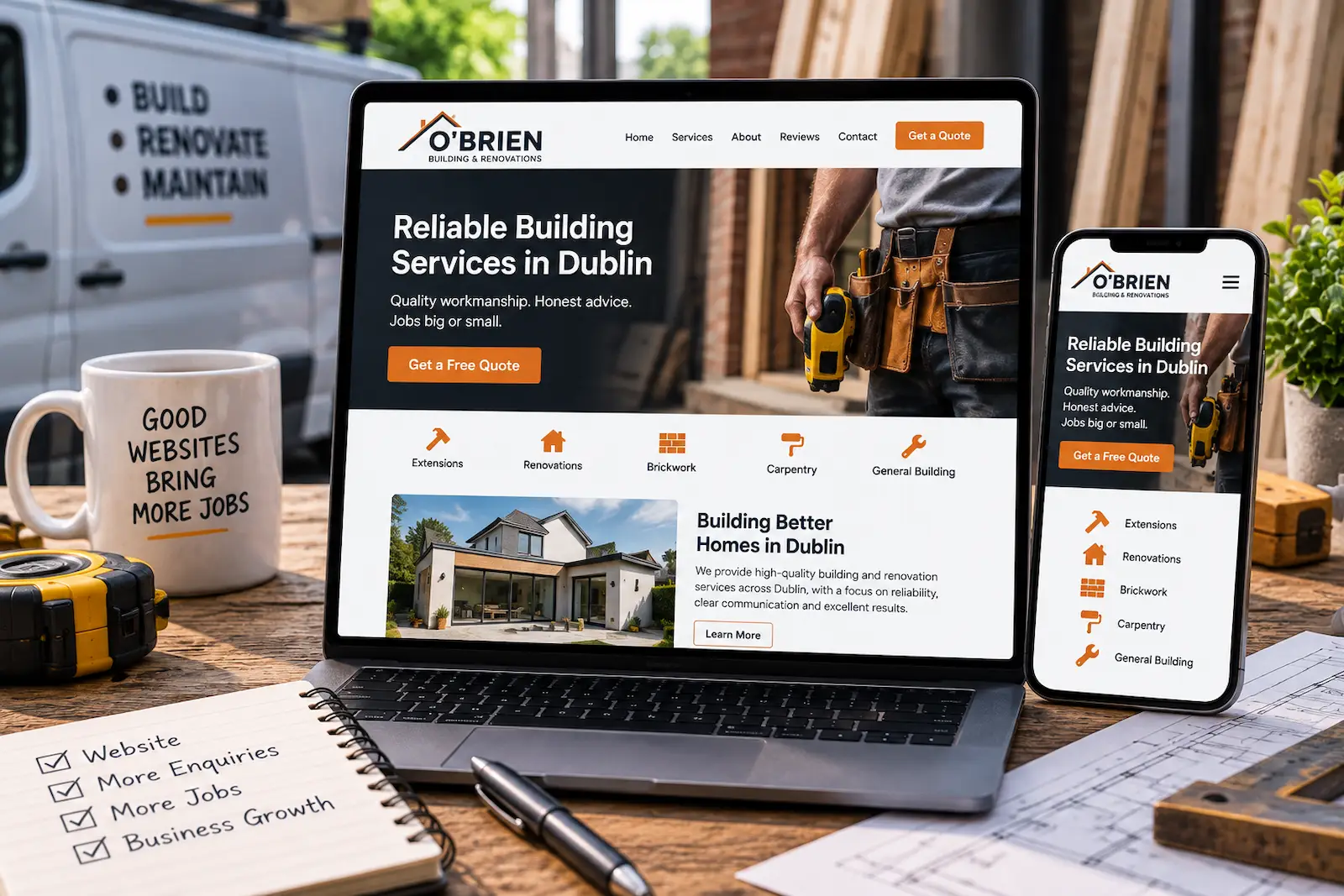
Not every trades business needs a massive website.
If you're a self-employed plumber, electrician, carpenter, roofer, landscaper, or builder, a simple one-page website might seem like everything you need.
Your services.
Your reviews.
A few project photos.
Your phone number.
Job done.
And sometimes, it genuinely is.
One-page websites also have limitations, particularly when you want to attract customers through Google, promote several services, or target multiple locations.
So, are one-page websites actually good for tradespeople?
The answer depends on what you expect your website to achieve.
In this guide, we'll look at the advantages and disadvantages of one-page trade websites, when they make sense, and when it's worth investing in a larger website.
Understanding One-Page Trade Websites
What Is a One-Page Website?
A one-page website contains most or all of the important information about your business on a single page.
Instead of separate pages for:
- About
- Services
- Reviews
- Gallery
- Areas Served
- Contact
these sections appear one after another on the homepage.
Navigation buttons may simply scroll visitors down to the relevant section.
This can create a straightforward experience and work particularly well for smaller businesses with relatively simple website requirements.
One page for all your needs.
The Advantages of a One-Page Trade Website
There are several good reasons to choose a one-page website.
For the right business, simplicity can actually be an advantage.
They're Simple for Customers
A potential customer doesn't necessarily want to explore twenty pages before finding your phone number.
A well-designed one-page website can quickly show them:
- What you do
- Where you work
- Examples of your work
- Customer reviews
- How to contact you
Everything is in one place.
For straightforward businesses, that's often exactly what customers need.
They Can Be More Affordable
A smaller website generally requires less work to design, develop, write, and maintain.
That can make a one-page website an attractive option for:
- Newly established tradespeople
- Sole traders
- Businesses with limited marketing budgets
- Businesses that primarily rely on referrals
You can establish a professional online presence without immediately investing in a much larger website.
If you're comparing different options, our guide on how much a trade website really costs explains the factors that can influence what you pay for a business website.
They Can Be Quick to Launch
If you're starting a new trade business, getting something professional online quickly can be valuable.
A focused one-page site can include the essentials without spending weeks preparing dozens of pages.
You can always expand it later as your business grows.
They Work Well on Mobile
A good one-page design can create a particularly simple mobile experience.
Customers can scroll through:
- Services
- Projects
- Reviews
- Service areas
- Contact details
without constantly moving between pages.
For local trade businesses, where potential customers may be browsing on their phones, that simplicity can be particularly useful.
Whatever website structure you choose, it still needs to work properly on smaller screens. Our guide on why mobile-friendly websites matter for tradespeople explains why the mobile experience is so important for trade businesses.
They're Better Than Having No Website
Some tradespeople delay building a website because they think they need something enormous with hundreds of service and location pages.
They don't.
A professional one-page website is usually far better than having no proper website at all.
It gives potential customers somewhere to:
- Verify your business
- View your work
- Read reviews
- Understand your services
- Contact you
You can build from there.
The number of pages matters less than whether the website does its job properly. Our guide on what makes a good trade website looks at the wider elements that can make a website useful for both your business and potential customers.
The Disadvantages of a One-Page Website
The simplicity that makes a one-page website attractive can eventually become its biggest limitation.
This is particularly true as your business grows.
SEO Can Be More Limited
One of the biggest disadvantages is search engine optimisation.
Imagine you're an electrician offering:
- House rewiring
- EV charger installation
- Consumer unit upgrades
- Fault finding
- Outdoor lighting
With a one-page website, all of those services compete for space on the same page.
Certainly all the services can be listed, but a larger website means you could create a dedicated page for each service.
For example:
/house-rewiring
/ev-charger-installation
/fault-finding
Each page can then explain that service in detail while targeting searches specifically related to it. This gives search engines more context about what your business offers and creates additional opportunities for potential customers to discover your website.
You Have Less Space to Explain Services
Some jobs need more explanation than others.
A short paragraph may be enough for a simple repair service.
It probably isn't enough to properly explain:
- House extensions
- Full rewires
- Bespoke carpentry
- Complete garden transformations
- Roof replacements
Dedicated service pages allow you to answer questions, showcase relevant projects, explain your process, and build confidence around each service.
Targeting Multiple Locations Becomes Difficult
Many trades businesses serve several towns or areas.
For example, a roofer might work across multiple locations, but trying to target every service and every location on one page quickly becomes messy.
Separate, genuinely useful location pages provide much more room to explain where you work and can support your local SEO strategy.
If attracting customers from local searches is important to your business, our guide on why local SEO matters for tradespeople explains how your wider online presence can help you appear in front of nearby customers.
One Page Can Become Very Long
There's a slightly ironic problem with one-page websites.
Businesses keep adding information until their "simple" website becomes enormous.
Services.
About.
Reviews.
Gallery.
FAQs.
Areas.
Process.
Contact form.
More services.
More reviews.
Another gallery.
Eventually you've created a page long enough to require provisions for the journey to the footer.
At that point, splitting the content into logical pages usually creates a better experience.
Choosing Between a One-Page and Multi-Page Website
When Is a One-Page Website Enough?
A one-page website can be an excellent choice if:
- You're newly self-employed.
- You offer a small number of services.
- You operate within a relatively small area.
- Most of your work comes through referrals.
- You mainly need a professional online presence.
- Your marketing budget is currently limited.
- You plan to expand the website later.
In these situations, simplicity can make perfect sense.
You don't need ten pages simply because another business has ten pages.
You need a website built to the requirements of your business.
When Should You Choose a Multi-Page Website?
A larger website becomes more valuable when:
- You offer several important services.
- You want to target multiple locations.
- SEO is an important source of future leads.
- You have lots of completed projects to showcase.
- You publish helpful content.
- You want to attract different types of customers.
- Your business is growing.
A multi-page structure gives your website room to grow alongside the business.
One-Page vs Multi-Page Website
Consider a landscaping company offering:
- Garden design
- Patios
- Driveways
- Fencing
- Decking
- Artificial grass
A one-page website could briefly explain all six.
A multi-page website could have a dedicated page for each.
That allows every service page to include:
- Detailed information
- Relevant project photos
- Customer reviews
- Frequently asked questions
- Calls to action
For customers researching a substantial project, that additional information can make a meaningful difference. It can also provide the extra reassurance that convinces them to go ahead and contact your business.
When every service is squeezed onto one long page, important information can also become harder for visitors to find.
What Should a One-Page Trade Website Include?
If you choose a one-page website, it still needs the right content.
At minimum, consider including:
- A clear introduction
- Your main services
- Areas served
- About your business
- Customer reviews
- Project photos
- Trust signals
- Frequently asked questions
- Phone number
- Contact form
- Strong calls to action
The exact combination will depend on the business, but our guide to the best website features for tradespeople looks more closely at the elements that can help a trade website build trust and generate enquiries.
A small website doesn't have to feel incomplete.
The goal is to make every section useful.
Don't Sacrifice Quality for Simplicity
One page doesn't mean throwing together a logo, phone number, and three sentences.
Your website should still be:
- Professionally designed
- Mobile-friendly
- Fast
- Secure
- Easy to navigate
- Clear about your services
A smaller website should feel intentionally simple rather than unfinished.
There's an important difference.
SEO and Future Growth
Can a One-Page Website Rank on Google?
Yes.
Having a one-page website doesn't automatically prevent you from appearing in search results.
A strong single page can still rank for relevant searches, particularly for your business name, core services, and some local searches.
However, you have fewer pages available to target different search intents.
If organic search is going to be an important part of your lead-generation strategy, a multi-page website usually provides more opportunities.
Can You Start With One Page and Expand Later?
Absolutely.
In fact, this can be a sensible approach for a new trades business.
You might start with:
Homepage
Then gradually add:
- Individual service pages
- About page
- Project gallery
- Location pages
- FAQs
- Helpful guides
Your website doesn't have to reach its final form on launch day.
Like the business itself, it can develop over time.
Choose the Website Around Your Business Goals
Think About Your Business Goals
The number of pages isn't really the important question.
Ask what you need the website to accomplish.
If you simply need somewhere professional to send referral customers, one page may be enough.
If you want Google to become a significant source of leads across several services and locations, you'll probably benefit from a broader website structure.
Choose the website around the business strategy—not an arbitrary page count.
If budget is limited, focusing on a strong one-page website can be better than spreading your resources across a weak or unfinished multi-page site.
The important thing is choosing a structure that suits your current business while leaving room to expand when it makes sense.
Don't Build Pages Just for the Sake of It
More pages aren't automatically better.
Five useful pages are better than twenty thin pages containing almost identical information.
Every page should have a purpose.
It should help:
- Answer a customer question
- Explain a service
- Showcase your work
- Target a meaningful search
- Build trust
- Generate an enquiry
If it doesn't accomplish anything useful, you probably don't need it.
Final Thoughts
So, are one-page websites good for tradespeople?
Yes—for the right business.
A well-designed one-page website can be an affordable and effective solution for a sole trader, new business, or tradesperson with straightforward services.
But it has limitations.
As your business grows, a multi-page website gives you more opportunities to:
- Target individual services
- Target different locations
- Improve your SEO
- Showcase projects
- Answer customer questions
- Generate organic leads
The best website isn't the one with the most pages.
It's the one that matches where your business is today while giving you room to grow tomorrow.
Sometimes one page is all you need.
Just don't try squeezing an entire novel onto it.