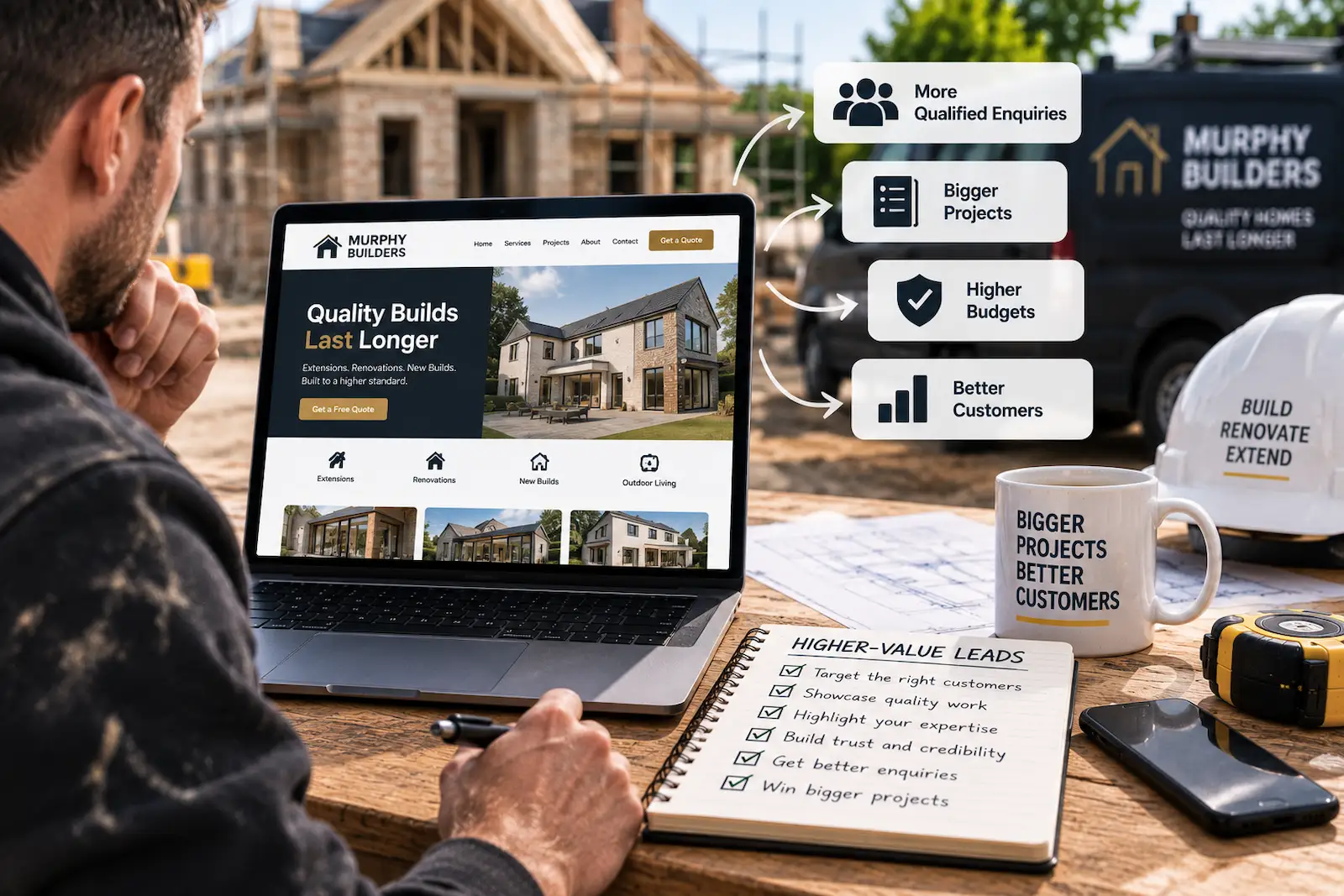
More leads don't always mean more business.
Ask any experienced builder who has spent an evening preparing a detailed quote for someone who was never realistically going to hire them.
The real goal isn't necessarily to generate the largest possible number of enquiries.
It's to attract better opportunities.
For a building company, that could mean homeowners planning:
- Extensions
- Major renovations
- New builds
- Loft conversions
- Structural alterations
- Commercial projects
These jobs can be considerably more valuable than minor repairs or enquiries that don't match the type of work you want.
So how do you attract more of the jobs you want?
It starts with making sure your marketing reflects the projects you actually want to win.
Define the Building Projects You Actually Want
Define What a Higher-Value Lead Means to Your Business
"Higher value" doesn't mean the same thing for every builder.
A sole trader and a larger construction company may have completely different ideal projects.
Before changing your marketing, define what you're actually trying to attract.
Consider:
- Preferred project types
- Minimum job size
- Geographic area
- Ideal customer
- Available capacity
- Profit margins
- Services you want to grow
If you don't know what a good lead looks like, it's difficult to build your marketing around attracting one. Defining what a higher-value lead means to your business is the starting point.
Lead value isn't determined by project size alone. Our guide on what makes a high-quality trade lead looks at the factors that can make one enquiry considerably more valuable than another.
Don't Market Yourself as Everything to Everyone
If your website says:
"All building work undertaken."
it doesn't give potential customers much information about where your expertise lies.
If you specialise in extensions and major renovations, say so.
For example:
Residential extensions and renovations across Location A and Location B.
That's much clearer for potential clients.
Good positioning helps the right customers recognise that your business is relevant to their project.
Make Your Best Services Prominent
Your website should prioritise the services you want the most work from.
If extensions are your ideal work, don't hide them halfway down a generic services list.
Make them prominent. Make it obvious.
Your main navigation and homepage might highlight:
- House Extensions
- Renovations
- New Builds
- Loft Conversions
You can still mention smaller services where appropriate.
But your marketing should reflect your business priorities.
Stop Chasing Every Possible Job
One of the hardest changes for a growing building business is learning that not every enquiry deserves the same attention.
If your goal is to grow higher-value projects, you may need to become more selective.
That could mean prioritising:
- Better-fit customers
- More profitable services
- Suitable locations
- Realistic budgets
- Projects that match your team's strengths
Being busy and being profitable aren't always the same thing.
Build Your Website Around Higher-Value Projects
Create Dedicated Service Pages
Higher-value building projects involve significant research.
A homeowner planning a €100,000 extension probably wants more information than:
"We do extensions. Contact us for a quote."
Create detailed pages for your important services.
An extension page could cover:
- Types of extensions
- Your building process
- Previous extension projects
- Typical stages
- Frequently asked questions
- Areas served
- How to request an initial consultation
Give serious customers enough information to evaluate your business properly and build confidence in your ability to deliver the project.
Show the Type of Work You Want More Of
Your portfolio influences the enquiries you receive.
If your website mainly shows:
- Small repairs
- Garden walls
- Minor maintenance
customers may assume that's what you specialise in.
If you want more:
- Extensions
- Full renovations
- New builds
make those projects the centrepiece of your portfolio.
Your website should show customers:
"This company regularly handles projects like mine."
Create Detailed Project Case Studies
A gallery can be extremely useful to showcase previous work.
A case study can be even more persuasive.
Instead of uploading six photographs with no explanation, turn your strongest projects into individual pages.
A case study might include:
- Project location
- Customer requirements
- Scope of work
- Challenges
- Building process
- Materials
- Before photographs
- Progress photographs
- Finished result
- Customer testimonial
This demonstrates much more than the final appearance.
It shows how you approach substantial projects and gives potential customers more evidence of your ability to deliver them successfully.
Use Professional Project Photography
You don't necessarily need professional photography for every job.
But your biggest and best projects deserve strong images.
Photograph:
- Exterior finishes
- Interior spaces
- Structural work
- Extensions
- Kitchens
- Bathrooms
- Joinery
- Architectural details
- Before-and-after transformations
Good photography helps customers understand the standard of your work.
For a high-value project, presentation matters.
Show Projects at Different Stages
Finished photographs are important.
But construction progress can also build credibility.
Consider showing how the work developed by including photos such as:
- Groundworks
- Structural stages
- Roofing
- Insulation
- First fix
- Second fix
- Finishing
- Completed project
This demonstrates that you're genuinely involved in the work rather than simply displaying attractive finished rooms.
It also helps customers understand the scale of what your business can handle.
Build Trust Before Customers Contact You
Build Trust Before the First Conversation
Hiring a builder for a major project involves significant risk from the customer's perspective.
They're trusting someone with their property, their budget, and months of building work.
Your marketing needs to reduce that uncertainty.
Trust can be strengthened by including:
- Customer reviews
- Real projects
- Business information
- Professional branding
- Relevant qualifications
- Insurance information where appropriate
- Clear communication
- A professional website
For larger projects, your website can play an important role in establishing that confidence before you ever speak to the customer. Our guide on why trust matters for builder websites looks at the elements that can make a building company appear more credible online.
Higher-value customers usually conduct more research.
Give them genuine evidence of your experience rather than the same generic claims they could find on almost any builder's website.
Explain Your Building Process
Large building projects can feel intimidating to homeowners.
Explain what working with you actually involves from start to finish.
A clear process makes your company appear organised, and organisation becomes increasingly important as project values rise.
Use Customer Reviews Strategically
A review saying:
"Great builder."
is somewhat useful.
A detailed review describing a six-month extension project is much more relevant to someone considering a similar investment.
Where possible, showcase reviews relating to the work you want more of.
Reviews that mention your communication, reliability, organisation, and quality of work can be particularly valuable for customers considering a substantial project.
Comments about budget management, project management, cleanliness, problem-solving, or how you handled unexpected issues can also address concerns future customers are likely to have.
These details address the concerns future customers are likely to have.
Get Found by Customers Looking for Building Services
Focus on Local SEO
Higher-value customers still need to find your business.
Local SEO can help you appear when people search for services in your area.
Examples might include:
- Extension builder near me
- House renovation company in Location A
- Builder in Location B
- Home extension contractor
- Renovation builder near me
Optimise your website around genuine services and genuine locations.
If organic search is an important part of your lead-generation strategy, our guide to SEO for builders explains how building companies can improve their visibility for relevant services and local searches.
Optimise Your Google Business Profile
Your Google Business Profile can be particularly valuable for local visibility.
Keep it updated with:
- Correct business information
- Services
- Service areas
- Opening hours
- Website
- Customer reviews
- Recent project photographs
Potential customers may investigate your profile before visiting your website.
Make sure the two support each other and are both maintained with the same information.
Conflicting information between your website and Google Business Profile can create unnecessary doubt about which information is correct.
Generate More Customer Reviews
Satisfied customers can become one of your strongest marketing assets.
After successfully completing a project, ask for a review.
For larger projects, detailed testimonials can be particularly valuable.
A homeowner considering a substantial renovation wants reassurance that you've successfully guided other customers through similar projects.
Build a Strong Referral Network
Referrals can produce excellent building leads because trust already exists.
Previous customers may recommend you to their friends, family, neighbours, or even their work colleagues.
Builders can also develop professional referral relationships, including with architects, engineers, interior designers, estate agents, and other tradespeople.
A recommendation from a trusted professional can put your business in front of customers planning substantial projects.
That existing trust is one reason referrals can produce particularly strong opportunities. Our guide on why referral leads are so valuable for tradespeople looks at why referred customers can be especially valuable and how trade businesses can generate more of them.
Help Serious Customers Take the Next Step
Answer Questions About Budget
Some businesses avoid discussing cost entirely.
That is a perfectly reasonable approach, but higher-value customers often need some understanding of whether their plans are realistic.
You don't necessarily need to publish fixed prices.
Building costs depend on too many variables for that.
Instead, explain:
- What affects project cost
- Why quotes vary
- How specification changes pricing
- Why site conditions matter
- What customers should consider when budgeting
Useful information can help educate customers before they contact you.
Providing this information can also help customers form more realistic expectations before they enquire, reducing the chance of conversations ending immediately because the project and budget are badly mismatched.
Make It Easy for Serious Customers to Contact You
Higher-value customers expect a straightforward experience when contacting your business.
Across your website and online presence, make sure to provide:
- Clear phone numbers
- Contact forms
- Email details
- Strong calls to action
- Mobile-friendly contact options
If someone has finally decided to enquire about a major extension, don't make them search through six pages to find your phone number.
Your enquiry form can also help you understand whether a project is a good fit. Asking for useful information such as the project type, location, approximate timeframe, and a brief description of the work can make the first conversation more productive.
Respond Quickly and Professionally
Marketing can generate the perfect lead, but poor follow-up can still lose it.
When someone enquires, respond promptly and ask relevant questions.
Clearly explain the next step and, where appropriate, arrange a follow-up call or site visit.
Higher-value projects often involve several builders being considered.
Professional communication can help separate your business from the competition.
Turn Better Enquiries Into Building Projects
Improve Your Quotation Process
Winning better leads isn't only about generating enquiries.
Your sales process matters too.
Professional quotations should be:
- Clear
- Well structured
- Easy to understand
- Consistent with your branding
- Detailed enough for the project
Customers spending significant amounts want confidence that the business behind the quote is organised.
Follow Up Your Quotes
Not hearing back doesn't always mean the customer has rejected you.
They may just be comparing options or waiting for finance. Others could be discussing details with their architects or simply reviewing the scope of the project.
A polite follow-up can bring the conversation back to life.
Don't assume every unanswered quotation is dead.
Measure the Real Value of Your Leads
Calculate What a Good Lead Is Worth
Suppose your average target project is worth €40,000.
If 10 suitable leads produce:
- 5 serious quotations
- 2 completed projects
those leads could represent substantial revenue.
Understanding your numbers helps you decide how much you're prepared to invest in:
- SEO
- Advertising
- Your website
- Content
- Other lead-generation channels
Higher-value work can justify a higher customer acquisition cost—provided the projects remain profitable.
The important question is whether that marketing spend ultimately produces profitable work. Our guide on what is a good ROI for trade marketing explains how lead costs, customer acquisition costs, margins, and completed jobs affect the real return from your marketing.
Track Which Projects Are Actually Most Profitable
The highest-revenue job isn't necessarily the best job.
Consider:
- Labour
- Materials
- Subcontractors
- Travel
- Equipment
- Project duration
- Management time
- Risk
A €50,000 project with poor margins may be less attractive than a €30,000 project that runs efficiently and produces healthy profit.
Your lead-generation strategy should ultimately target the work that's best for the business—not simply the projects with the largest headline value.
Use Marketing Channels That Attract the Right Customers
Use Paid Advertising Strategically
Google Ads can be useful when targeting people actively searching for specific building services.
But broad targeting can become expensive.
Focus campaigns around your important services and relevant locations while targeting high-intent searches.
Then track whether enquiries become actual projects.
Clicks aren't the goal.
Profitable building contracts are.
Combine Paid and Organic Marketing
Paid advertising can create immediate visibility.
SEO can build longer-term visibility.
Referrals create trust.
Your website converts interest into enquiries.
These channels work better together than in isolation.
A strong builder marketing strategy might combine:
- Local SEO
- Google Business Profile
- Website content
- Referrals
- Google Ads
- Project marketing
Over time, this creates multiple routes through which valuable customers can discover you.
Common Mistakes Builders Make When Generating Leads
Builders can attract the wrong enquiries when they:
- Market every possible service equally
- Have vague service pages
- Showcase the wrong projects
- Use poor project photography
- Ignore local SEO
- Have very few customer reviews
- Don't explain their process
- Fail to qualify enquiries
- Respond slowly
- Track lead numbers instead of completed jobs
Improving lead quality often starts with improving how the business presents itself.
Final Thoughts
Generating higher-value builder leads isn't about attracting everyone who needs something built.
It's about attracting more of the right projects from the right customers.
Start by clearly defining the work you want.
Then build your marketing around it:
- Create dedicated service pages
- Showcase your best projects
- Publish detailed case studies
- Invest in local SEO
- Optimise your Google Business Profile
- Build customer and professional referrals
- Collect strong reviews
- Publish useful content
- Qualify enquiries
- Track which leads become profitable projects
Your marketing should make it obvious what kind of builder you are and what kind of projects you specialise in.
Because 50 enquiries for work you don't really want aren't necessarily better than five enquiries for projects you do.
The goal isn't a busier inbox.
It's a better order book.