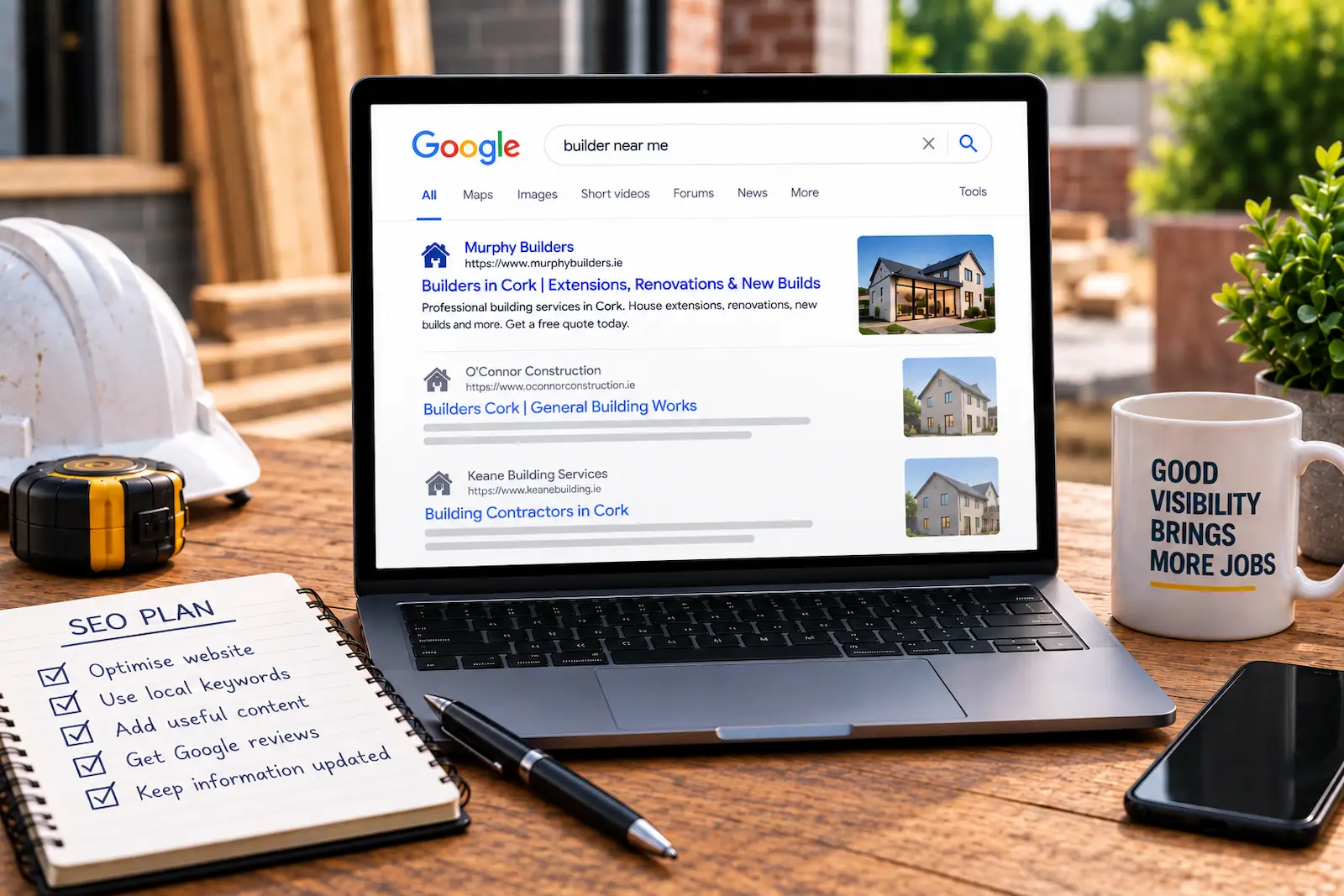
When someone needs a plumber, electrician, builder, roofer, landscaper, carpenter, or almost any other tradesperson, Google is often one of the first places they look.
They might search:
- Plumber near me
- Electrician in Location
- Local roofing company
- Builder for house extension
- Landscaper near me
- Carpenter for fitted wardrobes
Appearing prominently for searches like these can put your business in front of potential customers at exactly the right moment.
The problem?
Your competitors want those positions too.
Ranking higher on Google isn't about adding a few keywords to your homepage and waiting for the phone to ring.
Improving your Google rankings requires a combination of useful website content, strong local signals, genuine reviews, technical quality, and consistent effort over time.
In this article, we will focus on where tradespeople should place their effort.
Understand How Google Ranks Trade Businesses
Understand What Google Is Trying to Do
Before thinking about SEO tactics, it is best to understand the basic goal.
Google wants to provide useful results that match what someone is searching for.
If someone searches for:
"Roof repair near me"
Google wants to identify relevant roofing businesses that serve that particular area.
Your job is to make it easy for both customers and search engines to understand:
- Who you are
- What you do
- Where you work
- Why your business is relevant
- Why customers can trust you
A large part of trade SEO comes back to those fundamentals.
For trade businesses serving specific towns or regions, local visibility is especially important. Our guide on why local SEO matters for tradespeople explains how local search can help connect businesses with customers actively looking for their services.
Google can display different types of results depending on the search. For local trade searches, this may include Google Maps listings alongside traditional website results.
Your Google Business Profile can support visibility in local results, while your website content, technical quality, and other SEO factors influence your opportunities in organic search.
Build a Website Google Can Understand
Start With a Professional Website
Your website is the foundation of your organic search presence.
It should clearly explain what your business does, the areas it provides those services, your level of experience, and how customers can get in contact.
Another important signal would be genuine evidence of your work.
That might include a mixture of project photographs, reviews, case studies, and of course a selection of before-and-after images.
A website with almost no useful information gives both Google and customers very little to work with.
A good website should do more than simply look professional. Our guide to the best website features for tradespeople explores the elements that help turn a basic website into a useful tool for attracting enquiries.
Make Sure Google Can Find Your Website
Before worrying about rankings, make sure your pages can actually be discovered and indexed.
Your website should have these basics:
- Crawlable pages
- Clear navigation
- Internal links
- A sensible site structure
- An XML sitemap
- No accidental indexing restrictions
Google Search Console can help you understand whether Google is discovering and indexing your pages. If a page isn't indexed, it can't rank in normal organic search results.
Structure Pages With Clear Headings
Headings make content easier to understand.
For example, a roofing page might include:
- Roof Repair Services
- Common Roofing Problems
- Our Roof Repair Process
- Recent Roofing Projects
- Areas We Serve
- Frequently Asked Questions
Starting with a clear structure benefits visitors and helps search engines understand the page.
Build Strong Internal Links
Internal links connect relevant pages across your website.
For example:
A guide about extension costs could link to your:
House Extensions service page.
A project case study could link to both the relevant:
Service page
and:
Location page
Your homepage should also link prominently to your important services.
This creates a logical structure for customers and search engines.
Improve Your Local Google Visibility
Set Up Google Business Profile
For local tradespeople, Google Business Profile is extremely important.
It can help your business appear across Google Search and Google Maps.
Complete your profile with accurate information such as your business name, phone number, website, and business operating hours. Adding a business category along with services and service areas will help your business be found in the right searches.
Keeping your Google Business Profile accurate, relevant, and regularly updated helps potential customers find reliable information about your business.
If you're looking to improve your visibility in Google Search and Maps, our guide on why Google Business Profiles matter for tradespeople explains how profiles, services, reviews, and local visibility can help generate more enquiries.
Collect Genuine Google Reviews
Reviews can help potential customers trust your business and are an important part of your local presence.
Once a job has been completed successfully, make sure to ask the customer if they'd be willing to leave a review.
Make the process simple by sending them a direct link or by leaving a card.
Over time, collecting genuine reviews can demonstrate the quality, reliability, and professionalism of your business.
Don't buy fake reviews.
A strong reputation is worth considerably more than a suspicious collection of five-star accounts that all appeared last weekend.
Respond to Customer Reviews
Responding to reviews demonstrates that the business is active and engaged with its customers.
Thank people for positive feedback and respond calmly and professionally to negative criticism.
Your response isn't only for the person who left the review; it's also an indication of your business's attitude towards future customers.
Create Useful Location Pages
Location pages can help when your business genuinely serves several areas.
For example, a roofing company might have useful pages covering towns where it regularly works.
A location page could include:
- Services available in the area
- Projects completed nearby
- Local testimonials
- Relevant photographs
- Surrounding areas served
- Contact information
This provides potential customers with genuinely relevant local information.
Avoid mass-producing hundreds of nearly identical location pages with little useful information. These pages are unlikely to provide meaningful value to customers and can create SEO problems rather than solve them.
Quality beats scale.
Target the Services and Searches That Matter
Create a Page for Every Important Service
One of the biggest opportunities for trade websites is dedicated service pages.
Imagine you're an electrician offering:
- House rewiring
- EV charger installation
- Consumer unit upgrades
- Fault finding
- Outdoor lighting
Trying to properly optimise one homepage for every service is difficult.
Instead, create useful individual pages and ensure that each service has space to be properly explained.
Target the Services You Actually Want
SEO shouldn't generate random traffic. Instead, it should support your business goals.
If you're a carpenter who wants more fitted wardrobes or bespoke storage jobs, then these service pages deserve the most attention.
If you're a builder focused on extensions and renovations, make those services prominent.
Your SEO strategy should target the work you actually want to win.
Use Search Terms Naturally
Keywords help search engines understand your pages.
That doesn't mean repeating the same phrase twenty times. It means using the words naturally.
A page should sound like it was written for a homeowner, not a search engine from 2008.
Having optimised page titles with clear and descriptive wording for important pages will also help to target relevant keywords and accurately represent what the page contains.
Write Useful Meta Descriptions
A meta description gives you an opportunity to summarise the page for potential visitors.
For example:
Professional house rewiring services in Location. View our electrical services, recent projects, customer reviews, and request a quote.
Keep it clear and useful.
While meta descriptions don't directly improve rankings, and Google may generate a different description for search results, a clear and relevant description can help potential customers understand what your page offers and why the result is relevant.
Find Out Which Searches Generate Good Customers
Not every keyword has equal business value.
A builder might attract lots of traffic for:
DIY garden wall ideas
but very few customers.
Meanwhile:
House extension builder near me
may receive fewer searches but produce much stronger enquiries.
Focus on search intent, not just traffic volume.
The same principle applies to the enquiries your website generates. Our guide on what makes a high-quality trade lead explains why some enquiries are considerably more valuable than others, even when they come from the same marketing channel.
Demonstrate Your Experience and Expertise
Turn Major Projects Into Case Studies
For larger projects, go beyond a basic gallery.
A builder might create:
House Extension Project
A landscaper might publish:
Complete Garden Transformation
A carpenter could showcase:
Bespoke Fitted Wardrobes
These pages give potential customers detailed examples of relevant work.
Improve Your Website's Technical Performance
Optimise Your Project Images
Photographs are important for trades businesses, but enormous image files can slow websites down.
Optimise them using:
- Sensible dimensions
- Compression
- Modern image formats
- Descriptive file names
- Appropriate alt text
For example:
fitted-wardrobes.webp
is more descriptive than:
IMG_7428.webp
Keep file names accurate rather than stuffing them with keywords.
Adding accurate alt text helps describe images for accessibility and can provide useful context to search engines. Just make sure to describe what the image actually shows.
Improve Website Speed
Website performance affects the experience customers have when visiting your site.
Common causes of slow trade websites can include unoptimised images, excessive scripts, poor hosting providers, unnecessary animations, or bloated plugins.
A lightweight, efficient website is much less likely to frustrate someone searching for an emergency plumber than one that makes them sit through a twelve-second loading animation.
Make Your Website Mobile-Friendly
A large proportion of local searches happen on mobile devices.
Your website should be easy to use on a phone.
Check:
- Text size
- Navigation
- Forms
- Images
- Buttons
- Click-to-call phone numbers
Customers shouldn't need to pinch, zoom, and perform finger gymnastics just to request a quote.
Use HTTPS
Your website should use HTTPS.
It protects information transmitted between the visitor and website and has become a basic expectation for professional websites.
Modern hosting platforms often make HTTPS straightforward to implement.
There is little reason for a modern trade website not to use it.
Demonstrate Your Experience and Expertise
Create Helpful Content
Service pages target people who already know what they need.
Helpful articles can reach potential customers earlier.
For example, a builder could publish:
- How Much Does a House Extension Cost?
- How Long Does a Home Renovation Take?
- Extension vs Loft Conversion
A landscaper might cover:
- Patio vs Decking
- Best Low-Maintenance Garden Ideas
- How Much Does Landscaping Cost?
Answer questions your real customers are asking.
Build Trust Across Your Website
Google rankings matter, but ranking first is fairly pointless if customers don't trust what they find.
Use your website to demonstrate credibility through:
- Genuine reviews
- Real project photographs
- About information
- Experience
- Relevant qualifications
- Professional memberships where applicable
- Clear contact details
SEO gets attention, but trust helps turn that attention into business.
Build Your Website's Authority
Earn Relevant Backlinks
A backlink is a link to your website from another website.
Relevant links from trustworthy websites can help search engines discover your business and may support its credibility and visibility in search.
Potential opportunities for trades businesses include:
- Local organisations
- Professional associations
- Suppliers
- Business partners
- Local publications
- Genuine directories
Focus on earning legitimate links.
Hundreds of cheap links from websites you've never heard of aren't a substitute for a real reputation.
Relevant business directories can also be useful when customers genuinely use them to find local services. Focus on reputable directories, local business listings, and established trade-specific platforms rather than submitting your website everywhere purely for backlinks.
Turn Google Visibility Into Real Enquiries
Make It Easy to Contact You
Once someone finds you through Google, the next step should be obvious.
Provide:
- Click-to-call phone numbers
- Simple contact forms
- Email details
- Clear calls to action
Don't bury your phone number somewhere in the footer beneath the privacy policy.
Potential customers shouldn't need detective training to give you money.
A clear and easy mode of contact will make it much more appealing for potential customers to get in touch.
Track Leads, Not Just Rankings
Ranking improvements are useful, but rankings aren't the final business objective.
Track:
- Phone enquiries
- Contact forms
- Quote requests
- Jobs won
- Revenue
A page ranking fourth and generating excellent customers could be considerably more valuable than a page ranking first for a search that never produces business.
Commercial outcomes matter the most.
Keep Improving Your Google Rankings
Improve Pages That Already Show Potential
SEO doesn't always require creating something new.
Existing pages may already appear in Google without generating many clicks or ranking prominently.
These pages can be worth improving.
Look at:
- Search queries
- Titles
- Content quality
- Internal links
- Project examples
- FAQs
- Images
Sometimes improving an existing page is more valuable than publishing another one.
Regularly reviewing your existing pages is an important part of maintaining your website's usefulness. Our guide on how often tradespeople should update their website explains what deserves regular attention and when more substantial changes might be necessary.
Google Search Console can help identify pages receiving impressions without many clicks, searches where your pages are appearing, and potential indexing problems.
For example, a service page receiving impressions for relevant local searches but attracting few clicks may be worth reviewing. Check whether its title accurately describes the service, whether the content matches search intent, and whether the page provides enough useful information.
Don't assume that a low click-through rate automatically means something is wrong. Search position, competing results, and the type of search all influence how often people click.
Avoid SEO Shortcuts
Trying to manipulate rankings can create more problems than it solves.
Avoid tactics such as:
- Keyword stuffing
- Fake reviews
- Buying large quantities of low-quality backlinks
- Copying competitors' content
- Creating hundreds of thin location pages
- Hiding keywords on pages
Build something genuinely useful instead.
It's slower.
It's also considerably more sustainable.
Common SEO Mistakes Tradespeople Make
Common problems include:
- Having only a basic homepage
- Vague service descriptions
- No dedicated service pages
- Ignoring Google Business Profile
- Having very few reviews
- Poor mobile usability
- Slow websites
- Oversized images
- Thin location pages
- Weak internal linking
- No project content
- Tracking rankings but not enquiries
- Expecting instant results
Fixing the fundamentals can often accomplish more than chasing the latest SEO trick.
Final Thoughts
Ranking higher on Google as a tradesperson isn't about discovering one secret SEO technique.
It's about consistently giving Google and potential customers strong reasons to choose your business.
Focus on:
- A professional website
- Dedicated service pages
- Genuine local content
- Google Business Profile
- Customer reviews
- Real projects
- Helpful articles
- Strong internal linking
- Fast mobile performance
- Relevant backlinks
- Accurate business information
- Regular measurement
Most importantly, remember why you want higher rankings in the first place.
It's not to win an SEO trophy.
It's to put your business in front of more potential customers when they're actively searching for the work you provide.
Being number one on Google sounds nice, but being fully booked with profitable work sounds considerably better.