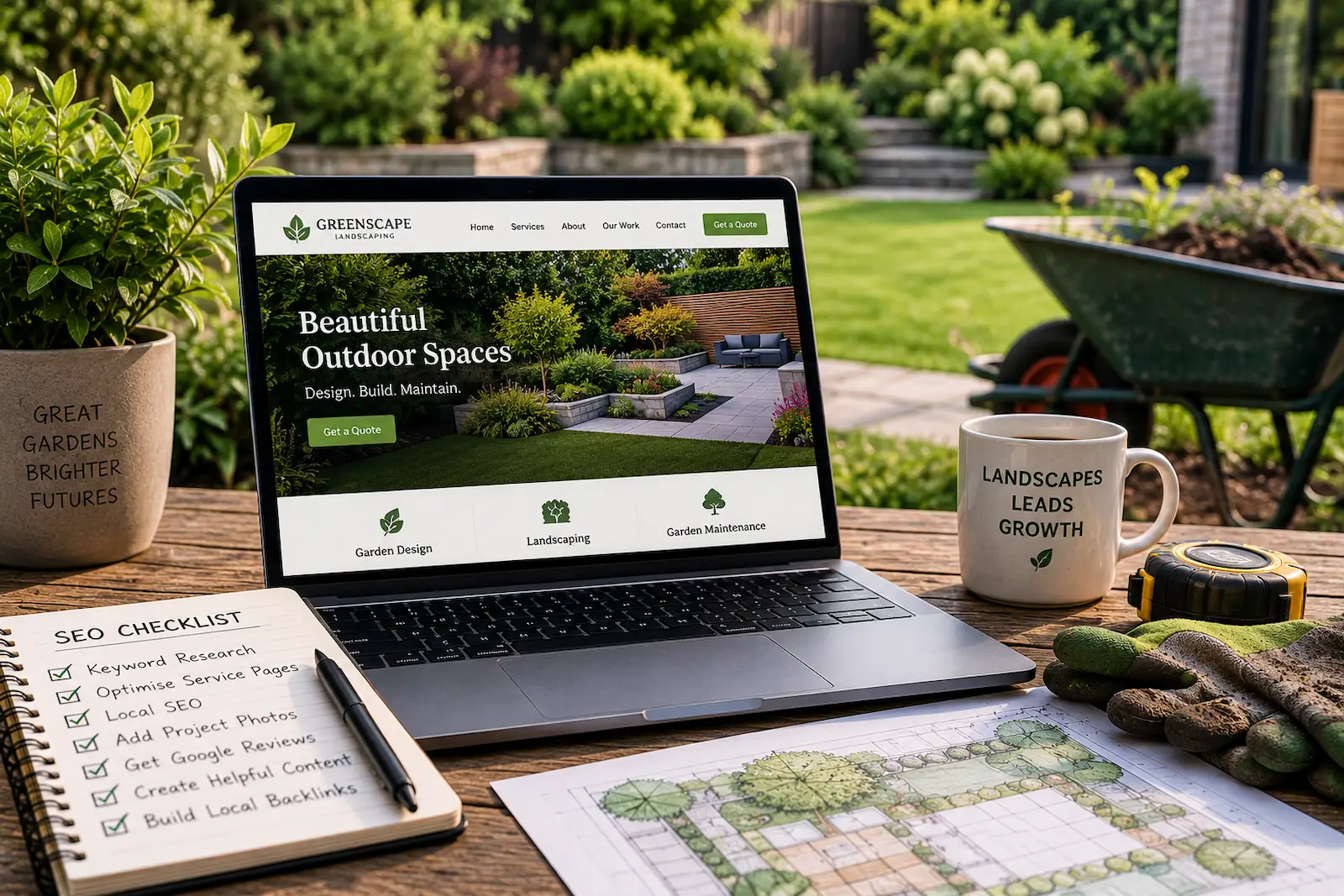
A beautiful garden doesn't generate many enquiries if nobody knows who created it.
The same applies to your landscaping website.
You might offer excellent patios, fencing, garden design, decking, driveways, and complete garden transformations, but potential customers still need to find you.
That's where search engine optimisation comes in.
SEO can help your landscaping business appear when local homeowners search Google for the services you provide.
Unlike advertising, you don't necessarily pay every time someone clicks.
The challenge is knowing where to start.
In this article we will look at some practical SEO tips landscaping businesses can use to improve their visibility and generate more local enquiries.
Get the Local SEO Basics Right
Most landscaping businesses operate within a specific geographic location.
That means you don't necessarily need to compete with every landscaper on the internet.
That would be a pointless exercise. Instead you need to become more visible to people in the places you actually serve.
Someone searching for:
- Landscaper near me
- Landscaping company in Location A
- Patio installer in Location B
- Garden designer near me
- Fencing contractor in Location C
has clear local intent.
Your SEO strategy should reflect that by focusing on the areas where your customers are situated.
If generating more enquiries from nearby customers is a priority, our guide on how landscapers can get more local leads covers some of the wider strategies you can use alongside SEO.
Set Up Your Google Business Profile
A Google Business Profile is an important part of local SEO.
It can help your landscaping business appear across Google Search and Google Maps.
Complete your profile by including accurate information such as your business name, contact number, website, opening hours, services and areas, and a clear description of your business.
Don't ignore your Google Business Profile after completing it. Keep your profile accurate and up to date rather than treating it as something you set up once and forget about. An outdated profile can also make a poor impression on potential customers.
Choose the Right Business Categories
Your Google Business Profile category should accurately describe what your company does.
Depending on your services, relevant categories may include landscaping-related options that genuinely reflect the business.
Choose your primary category carefully and only use additional categories that are relevant.
Don't select unrelated categories simply because you're hoping to appear in more searches.
Relevance matters. Selecting unrelated categories is unlikely to help you attract the customers you're actually looking for.
Collect Customer Reviews
Reviews can strengthen trust and support your overall local presence.
After completing a successful landscaping project, ask the customer if they'd be willing to leave a review.
The most useful reviews often naturally mention things such as what the project involved, the quality of the workmanship, how reliable you were, and the overall quality of the experience.
For example, a genuine review describing a new patio and garden redesign provides considerably more context than:
"Good job."
Both types of reviews are appreciated, but one is quite simply a little more useful.
Build Better Service and Location Pages
Create a Page for Each Important Service
One of the biggest SEO opportunities for landscaping companies is dedicated service pages.
Imagine you provide:
- Garden design
- Patios
- Paving
- Fencing
- Decking
- Artificial grass
- Driveways
- Garden maintenance
Trying to properly explain every service on one page can be difficult.
Instead, create useful individual pages for your most important services.
Service pages are only one part of a strong landscaping website. Our guide to the best website ideas for landscapers covers project galleries, reviews, quote forms, and other ways to make your website more useful to potential customers.
Each page can focus on what customers need to know about that particular service.
Make Service Pages Actually Useful
Creating a page on a website doesn't automatically make it good SEO.
A useful patio page might explain:
- Types of patios you install
- Materials available
- Your process
- Relevant project examples
- Frequently asked questions
- Areas served
- How to request a quote
Include genuine information that helps someone decide whether your business is suitable.
Avoid creating dozens of nearly empty pages just to target keywords, or worse, repetitive pages with little to no distinction between them.
Create Genuine Location Pages
If you regularly work across several towns or areas, location pages can help explain your geographic coverage.
Each page should contain genuinely useful local information which could include:
- Services available in the area
- Projects completed nearby
- Relevant photographs
- Testimonials from local customers
- Areas surrounding the town that you serve
Simply copying the same page fifty times and changing the town name isn't a strong local SEO strategy.
It's mostly a strong copy-and-paste strategy, but Google Rankings can see through that disguise.
Don't Create Location Pages for Everywhere
More location pages don't automatically mean more traffic.
Focus on areas where you genuinely work and want additional customers.
Your website should accurately reflect your real service area. Including every crossroads with a house, or every winding path with a couple of buildings, is unlikely to bring in more leads.
Use the Words Customers Actually Search For
Tradespeople sometimes describe services differently from customers.
SEO requires thinking about the language homeowners use when searching.
For example, customers might search for:
- Garden makeover
- New patio
- Garden fencing
- Landscaping company
- Garden designer
- Driveway installer
- Low-maintenance garden
Your website can naturally use different relevant phrases while still describing your services accurately.
Don't force keywords into every sentence.
Step into the shoes of your customer and write from their perspective.
Optimise Your Landscaping Website
Optimise Your Page Titles
Each important page should have a clear title that explains what it's about.
Instead of something vague such as:
Services | ABC Landscaping
For a genuine patio service page serving a particular area, consider something more descriptive:
Patio Installation in Location | ABC Landscaping
The title should accurately represent the page, but not be used for mass producing pages.
It helps search engines and potential customers understand what they'll find.
Write Useful Meta Descriptions
Meta descriptions can provide searchers with a short summary of the page.
Keep them clear and relevant.
For example:
Professional patio installation in Location. Explore our paving options, recent landscaping projects, and request a quote from ABC Landscaping.
Avoid stuffing them with every keyword you can think of because their main job is to help people understand the result, not impress Google Ranking Bots.
Use Clear Page Headings
Your headings should organise the page logically.
A garden design page might include sections such as:
- Garden Design Services
- Our Design Process
- Garden Design Ideas
- Recent Projects
- Areas We Serve
- Frequently Asked Questions
Clear structure makes pages easier for visitors to scan and helps search engines understand the content.
Use Your Landscaping Projects to Improve SEO
Turn Completed Projects Into SEO Content
Landscaping businesses have an excellent source of unique website content, their complete projects.
Instead of only adding photographs to a gallery, create useful project case studies.
For example:
Garden Transformation in Location
The page could explain:
- What the customer wanted
- Challenges with the original garden
- Work completed
- Materials used
- Project location
- Before-and-after results
Now one project demonstrates your expertise while creating useful local content.
Imagine landing on a project page where the entire project is shown and described from start to finish. It immediately instils belief in a potential client that you can deliver on their project.
Use Before-and-After Photos
Landscaping is particularly suited to before-and-after photography.
An overgrown or unused garden transformed into a finished outdoor space immediately demonstrates what your business can achieve.
Use these images throughout:
- Service pages
- Project pages
- Homepage
- Google Business Profile
- Social media
Your completed work is one of your strongest marketing assets, so start using it properly.
Make Your Website Fast, Mobile-Friendly, and Easy to Use
Improve Website Speed
Large image galleries can slow landscaping websites down.
A slow website can frustrate visitors, particularly on mobile connections.
Improve performance by:
- Compressing images
- Avoiding unnecessarily large files
- Using efficient image formats
- Limiting excessive scripts
- Choosing reliable hosting
- Keeping the website technically well maintained
Beautiful project photography shouldn't require enough loading time to grow the garden again. Compressing and properly sizing your images can improve website performance, while useful descriptive alt text can help search engines and users understand what the images show.
Make Your Website Mobile-Friendly
Potential customers frequently search for local tradespeople from their phones.
Your website should therefore work properly on smaller screens.
Make sure that the text is readable, images scale correctly, buttons are easy to tap, navigation is extremely simple and usable, contact forms work properly, and phone numbers are clickable.
Mobile usability isn't an optional extra for a modern landscaping website. It's not the early 2010s anymore, and your website shouldn't behave as though it is.
Make Contact Easy
SEO gets visitors to the website.
Your website still needs to turn them into enquiries.
Include clear contact options throughout the site.
A clear lead-generation strategy is an important part of a successful trade website. Getting visitors from Google means little if the website makes it difficult for them to enquire.
These might include:
- Phone number
- Contact form
- Request-a-quote buttons
Don't make customers hunt for the contact page.
If requesting a landscaping quote feels like navigating a hedge maze, something has gone wrong.
Getting more enquiries is useful, but quality matters too. Understanding what makes a high-quality trade lead can help you focus on attracting customers who are actually a good fit for your landscaping services.
Publish Content That Helps Potential Customers
Publish Helpful Landscaping Content
Blog content can help you target questions customers ask before hiring a landscaper.
Useful topics might include:
- How Much Does a New Patio Cost?
- Best Low-Maintenance Garden Ideas
- Patio vs Decking: Which Is Better?
- How Much Does Garden Landscaping Cost?
- Best Materials for Garden Paths
- How Long Does a Garden Transformation Take?
- When Is the Best Time to Landscape a Garden?
Good content can attract people earlier in their research process.
It also gives you opportunities to internally link to your relevant services.
Answer Real Customer Questions
One of the easiest ways to find content ideas is to think about what customers repeatedly ask you.
If five customers have asked:
"Can you install a patio during winter?"
there are probably other homeowners searching for the same answer.
Your everyday conversations can become useful website content.
Think about what your clients ask. Consider how that can help you succeed in your local area.
Add Frequently Asked Questions
FAQs can improve important service pages by answering common concerns.
For example, a patio page might answer:
- How long does patio installation take?
- What patio materials do you offer?
- Do you remove the existing patio?
- Do you provide drainage?
- How much does a patio cost?
Useful answers reduce uncertainty and help customers understand your service.
Strengthen Your Landscaping Business's Online Presence
Earn Relevant Local Links
Links from other reputable websites can help strengthen your site's authority.
For landscaping businesses, opportunities might come from:
- Local business organisations
- Suppliers
- Professional associations
- Community organisations
- Local publications
- Businesses you've genuinely partnered with
Focus on relevant, legitimate links.
Buying hundreds of random backlinks from mysterious websites isn't a shortcut worth taking.
Keep Your Business Details Consistent
Your business name, phone number, website, logo, and other core details should be consistent across important online listings.
Check places such as:
- Google Business Profile
- Your website
- Relevant directories
- Social profiles
Inconsistent information can confuse customers.
Keeping your basic details accurate is one of the simplest things you can control.
Showcase Trust
SEO can bring someone to your website.
Trust helps turn them into a lead.
Include evidence such as genuine customer reviews, real project photography, your business experience, any relevant qualifications or professional memberships, and any guarantees you genuinely provide.
Keep your business information clear and avoid vague claims such as:
"Ireland's number one landscaping company."
Unless someone has actually handed you the trophy.
Specific evidence is much more convincing.
Build Your SEO Over Time
Keep Your Website Updated
A landscaping website shouldn't become a digital time capsule.
Continue adding:
- Recent projects
- New reviews
- Updated service information
- Fresh photographs
- Useful articles
You don't need to redesign the site every six months.
Just keep the information accurate and useful.
SEO Takes Time
It is important to understand that SEO isn't usually an instant source of leads.
New pages need time to be:
- Discovered
- Crawled
- Indexed
- Evaluated
- Ranked
Competitive local searches can take longer.
The advantage is that useful pages can continue attracting potential customers long after they're published.
This long-term visibility is one reason SEO can play an important role in generating leads without relying on paid ads.
Think of SEO as building an asset rather than switching on an advert. Our guide to organic leads vs paid leads explains the differences between these approaches and where each can fit into a trades business's marketing strategy.
Common Landscaping SEO Mistakes
Landscaping businesses often limit their search visibility by:
- Having only a basic homepage
- Not creating dedicated service pages
- Ignoring Google Business Profile
- Never collecting reviews
- Using poor-quality or oversized images
- Creating thin location pages
- Publishing duplicate content
- Ignoring mobile visitors
- Failing to showcase completed projects
- Expecting instant SEO results
Most of these aren't complicated technical problems.
They're usually gaps in how the business presents itself online.
Final Thoughts
Good SEO helps your landscaping business appear when local homeowners are already searching for the services you provide.
Start with the fundamentals:
- Build a professional website
- Optimise your Google Business Profile
- Create useful service pages
- Target genuine service areas
- Collect customer reviews
- Showcase real projects
- Optimise your images
- Publish helpful content
- Make the website fast and mobile-friendly
- Track which enquiries become customers
You don't need hundreds of pages or thousands of backlinks.
You need a useful website that clearly demonstrates what you do, where you do it, and why customers should trust you.
Your best landscaping projects already prove what your business can achieve.
Good SEO simply helps more local customers find them.